Pharmaceutical Mixer Guide: Types of Pharma Mixers and How to Choose
· PerMix Team
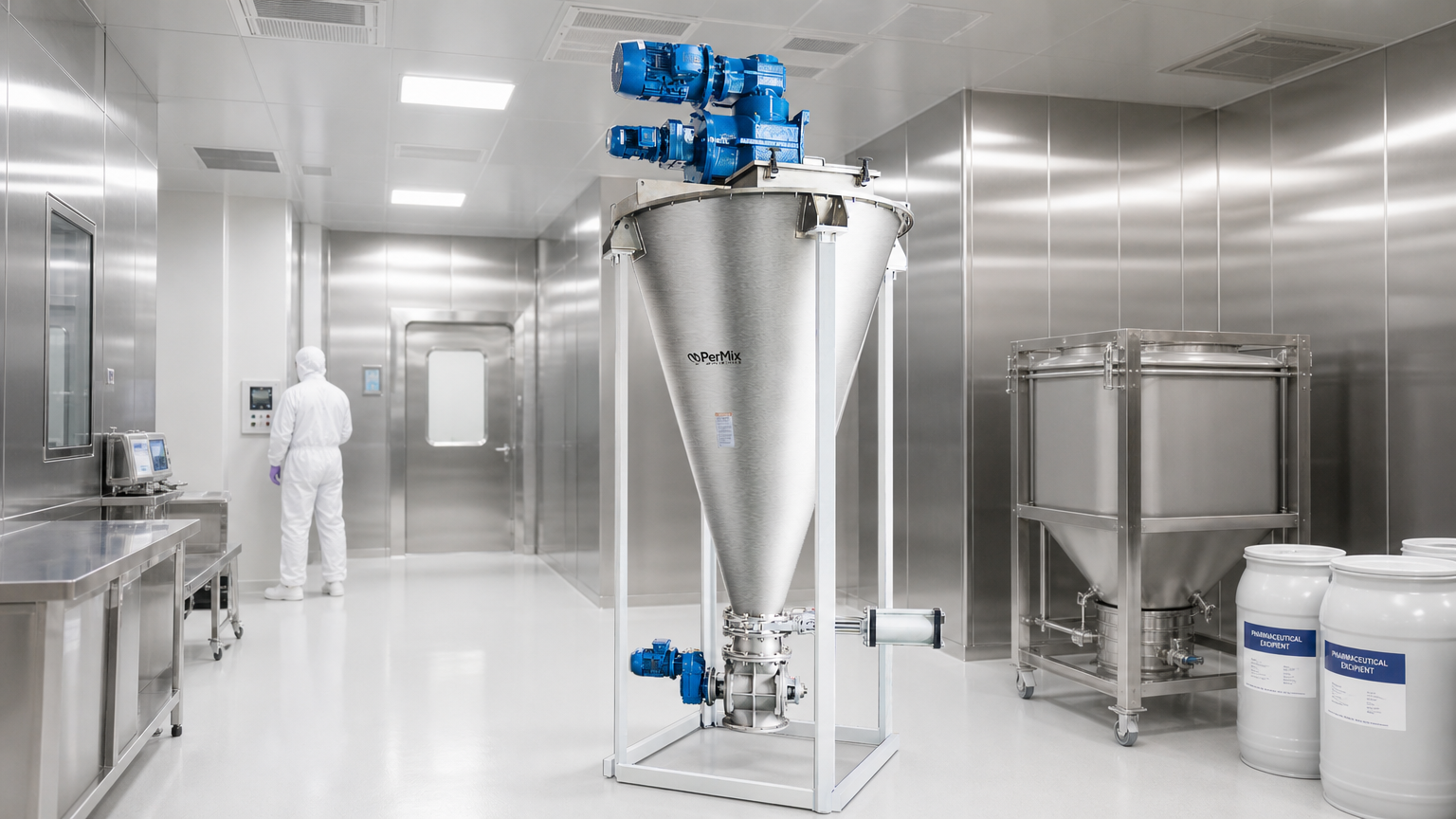
A plant floor guide to pharmaceutical mixers: types for oral solid dose powders, granulation, syrups, suspensions and ointments, cGMP and cleaning details, a selection checklist and common buying mistakes.
A pharmaceutical mixer is process equipment that blends active pharmaceutical ingredients (APIs), excipients and liquids into a uniform batch that can be validated, cleaned and repeated. In pharma, a mixer is never judged only by how fast it mixes. It is judged by blend uniformity, by what it leaves behind after cleaning, and by whether the same result comes out of every batch during an audit.
This guide is written from the plant floor point of view. It covers the main types of mixers in the pharmaceutical industry, which mixer fits which dosage form, the hygienic design details that matter for cGMP, and the mistakes we see most often when a pharma team picks a mixer. Every machine named here is part of the PerMix range for pharmaceutical mixing.
What is a pharmaceutical mixer?
A pharmaceutical mixer, often called a pharma mixer or pharmaceutical blender, is a mixing vessel with agitators, screws, paddles, high shear heads or a tumbling body, built from stainless steel and designed for cleaning and validation. It handles three broad jobs:
- Dry blending of powders for tablets, capsules and sachets, where a very small API dose has to be spread evenly through a large excipient mass.
- Liquid mixing and dispersion for syrups, suspensions and vaccines, where powders must dissolve or disperse without lumps.
- Heavy kneading and vacuum mixing for ointments, gels, creams and transdermal pastes.
The mixing principle changes from job to job, so there is no single best pharmaceutical mixer. The right choice depends on the product, the dose, the batch size and the cleaning regime.
Why pharmaceutical mixing is different
In food or chemical plants a small variation between batches may be acceptable. In pharmaceutical manufacturing it is not, because the mixing step controls how much API ends up in each tablet or each gram of cream. Three things make pharma mixing harder than general industrial mixing:
- Low dose APIs. A potent API may make up a tiny fraction of the blend. PerMix rates its paddle and plow mixers for mixing ratios up to 1:1,000,000, which means trace components down to 1 ppm can be distributed through the batch.
- Segregation. A well mixed powder can separate again during discharge, transfer or filling if particle size and density differ. The mixer, the discharge design and the transfer route all play a part.
- Cleaning and cross contamination. Multi product plants must prove that one product does not carry over into the next. Dead zones, product contact seals and hard to reach welds turn every changeover into a risk.
Types of mixers in the pharmaceutical industry
PerMix groups pharmaceutical mixers by the dosage form and the mixing duty. Here is how the main types compare in practice.
Mixers for oral solid dosage powders
Oral solid dosage (OSD) work is mostly powder blending before compression or encapsulation.
- Conical mixer (PNA): a cantilevered screw moves material up the wall and orbits the cone, which gives gentle three dimensional mixing with very little heat. It is a design PerMix has refined for more than 60 years and it suits fragile and heat sensitive blends. Sizes run from 30 L to 30,000 L, and a lab size of about 8 L working volume exists for R&D. More detail in our conical screw mixer guide.
- Paddle mixer (PTP) and plow mixer (PTS): aggressive, mechanically fluidized mixing for blends that need the 1:1,000,000 ratio and short cycle times. See the plow mixer guide for how choppers and plow speed affect a batch.
- Ribbon mixer (PRB): a versatile horizontal blender rated for a 1:500,000 ratio. Our ribbon mixer article explains how the inner and outer ribbons move material.
- Vertical ribbon mixer (PVR): a vertical alternative to the PRB for small floor space and residue free discharge, with the shaft seals above the working area.
- 3D mixer (PTU): a tumbling mixer with no internal agitator, gentle on coated pellets and dust free for substances with different specific weights.
Granulation mixers
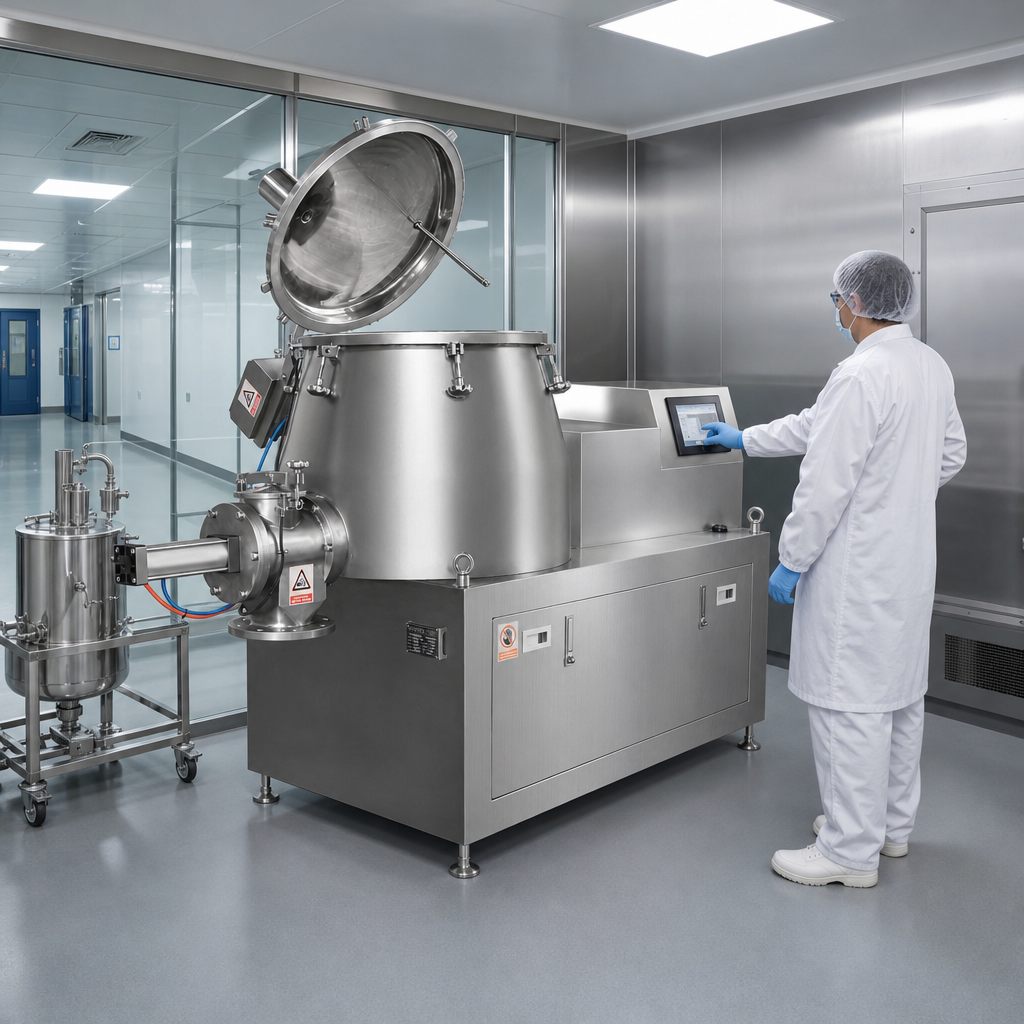
When a powder blend will not flow or compress well on its own, it is granulated. The high speed granulator (PDI) is a vertical high shear mixer with a central impeller and a side chopper. It dry blends the powders, takes the binder and forms granules in a very short time. Sizes run from 3 L lab units up to 1,500 L production bowls, and the PDI offers full clean in place (CIP). Our post on wet granulation goes deeper into the process.
Mixers for syrups, suspensions and vaccines
Low to medium viscosity liquids need shear plus good flow through the vessel.
- Shear pump (PCH): combines a centrifugal pump with an inline high shear mixer, from 3 kW to 37 kW and up to 40,000 L per hour. It pulls powder into the liquid stream and PerMix rates it at about 90% less process time than a conventional agitator. It is fully CIP capable.
- Inline emulsifier (PC): higher shear for stable emulsions and sterile suspensions, built in stainless steel for continuous operation inside an existing line. Our inline mixer guide compares the inline options.
Mixers for ointments, gels and transdermals
High viscosity products need torque, not speed.
- Sigma mixer (PSG): Z shaped blades stretch, fold and knead masses above 500,000 cPs. See the sigma mixer guide.
- Double planetary mixer (PDP): two tools orbit the vessel while turning on their own axes, rated for viscosities up to 1,500,000 cPs. More in the double planetary mixer guide.
- Multi shaft vacuum mixer (PMS): runs the whole cycle from feeding to a deaerated, ready to fill product. Vacuum stops air from being trapped in creams and gels, which protects stability and appearance.
Drying and deaeration
Two steps often sit next to the mixer. The vacuum mixer dryer (PTPD) uses a heated jacket and vacuum to lower the boiling point of solvents, so moisture and solvent come off at lower temperatures and heat sensitive APIs are protected. Read the vacuum dryer guide for when this pays off. The vacuum deaerator (PDA) removes trapped air from liquids before filling.
Low-shear vs high-shear mixing in pharmaceutical production
Before choosing the type of mixer, decide how much energy the product can take. Pharmaceutical mixing equipment falls into three groups:
- Low-shear tumbling mixers. The whole vessel turns, so the powders mix by diffusion with no blade touching the product. A V blender, also called a V-type mixer or twin shell blender, and the 3D mixer belong here. They are gentle mixing machines for free flowing, similar sized powders and for the final lubrication step. Our V blender guide explains when this rotary design works best.
- Convective mixers. Screws, ribbons or paddles move the powder inside a fixed vessel. A ribbon blender with a U-shaped trough, a conical screw mixer and a paddle mixer use convective mixing, and they can take small amounts of liquid sprayed onto the powder.
- High-shear mixers. A fast impeller and a chopper break every lump and turn wet powder into granules. This is the high speed granulator, and in liquids it is the shear pump or inline emulsifier that makes a stable emulsion.
Powder characteristics drive this choice: particle size, bulk density, flow, moisture and how fragile the raw materials are. A cohesive API that forms lumps needs more energy than a free flowing excipient. High-viscosity materials such as ointments need kneading, not speed. Good mixing systems also handle the steps around the mixing process: how the powder is fed, how it is discharged through butterfly valves or a sealed outlet, and how the batch moves to the next room without dust or segregation. That is why PerMix treats every project as a complete mixing solution for powder processing, from R&D to production, and not as a single machine.
Hygienic design and GMP details to check
Cleanability and cross-contamination control decide how easy the mixer is to clean and validate, and they matter as much as the mixing action.
- Materials. PerMix builds pharmaceutical mixers in SS304 and SS316L. For most product contact parts in pharma, SS316L is the usual choice.
- Seal position. On the PNA, PVR and PAM vertical mixers the shaft seals and bearings sit above the product zone, so lubricant or seal wear particles cannot fall into the batch. This supports cGMP compliance directly.
- Clean in place. The PCH and PDI series offer full CIP, which shortens changeovers and makes cleaning repeatable.
- Validation. Simple internal geometry and good surface finishes make IQ, OQ and PQ (installation, operational and performance qualification) easier, and help meet FDA and EU Annex 15 expectations on cross contamination.
- Discharge. Ask how much product stays in the vessel after discharge. Residue costs API and complicates cleaning validation.
How to choose a pharmaceutical mixer
Choosing the right mixer starts with the product, not the machine catalog. These are the questions our engineers ask first:
- What is the dosage form: powder for tablets or capsules, granules, liquid, suspension or semi solid?
- What is the lowest API concentration, and what blend uniformity target must you meet?
- Are the ingredients heat sensitive, fragile, abrasive or prone to segregation?
- What batch sizes do you need now and after scale up, and is there a lab size to run trials?
- How often do you change products, and what cleaning method (manual, WIP or CIP) will you validate?
- Do you need vacuum, heating, cooling or solvent recovery in the same vessel?
A quick rule from the field: gentle, heat sensitive OSD blends point to the conical mixer or the 3D mixer. Fast blends with trace components point to the paddle or plow mixer. Granulation points to the PDI. Liquids point to the shear pump or the inline emulsifier, and creams and ointments point to the PMS, PDP or PSG. If you are not sure, run your own material first at a PerMix test center before you commit to a size. Our wider powder mixer guide also helps when you are mixing powders and the choice is between several blenders.
Common mistakes when buying a pharma mixer
These are the mistakes we see again and again in pharmaceutical projects:
- Choosing by batch volume only. A mixer that is too large for the real fill level mixes poorly. Check the minimum and maximum working volume, not just the total.
- Over mixing the lubricant. Long blend times after adding a lubricant such as magnesium stearate can hurt tablet hardness. Plan the lubrication step as its own short stage.
- Ignoring discharge and transfer. A perfect blend can segregate on the way to the press. Look at the discharge valve, the transfer height and the container.
- Skipping trials with real material. Lab data on a similar powder is not your powder. Test with the actual API and excipients.
- Leaving cleaning validation for later. If the mixer has product contact seals or blind spots, the cleaning study will expose it after installation, when changes are expensive.
FAQ
What mixer is used in the pharmaceutical industry?
There is no single one. For tablet and capsule powders, conical screw, ribbon, paddle, plow and 3D tumbling mixers are common. For granulation, high speed mixer granulators are used. Syrups and suspensions use shear pumps and inline emulsifiers, and ointments use sigma, double planetary or multi shaft vacuum mixers.
What is a pharmaceutical blender?
It is another name for a pharmaceutical mixer, usually used for dry powder blending equipment such as conical, ribbon, V type or 3D mixers that bring APIs and excipients to a uniform blend.
How do you get good blend uniformity with a low dose API?
Use a mixer rated for very high mixing ratios, such as a paddle or plow mixer rated to 1:1,000,000, add the API in a pre blend or geometric dilution step, control blend time, and protect the blend from segregation during discharge.
Which pharmaceutical mixer is easiest to clean?
Designs with no product contact seals, smooth internal surfaces and full CIP are easiest. On PerMix vertical mixers the seals sit above the product zone, and the PCH and PDI series offer full CIP.
Can I test my product before buying?
Yes. PerMix runs trials with customer material at its test centers, which is the best way to confirm mixing time, uniformity and the right size.
Next step
Send us your formulation, batch size and cleaning requirements and our engineers will suggest the right pharmaceutical mixer and a trial plan. Request a quote.