Double Planetary Mixer Guide for High-Viscosity Pastes and Kneading
· PerMix Team
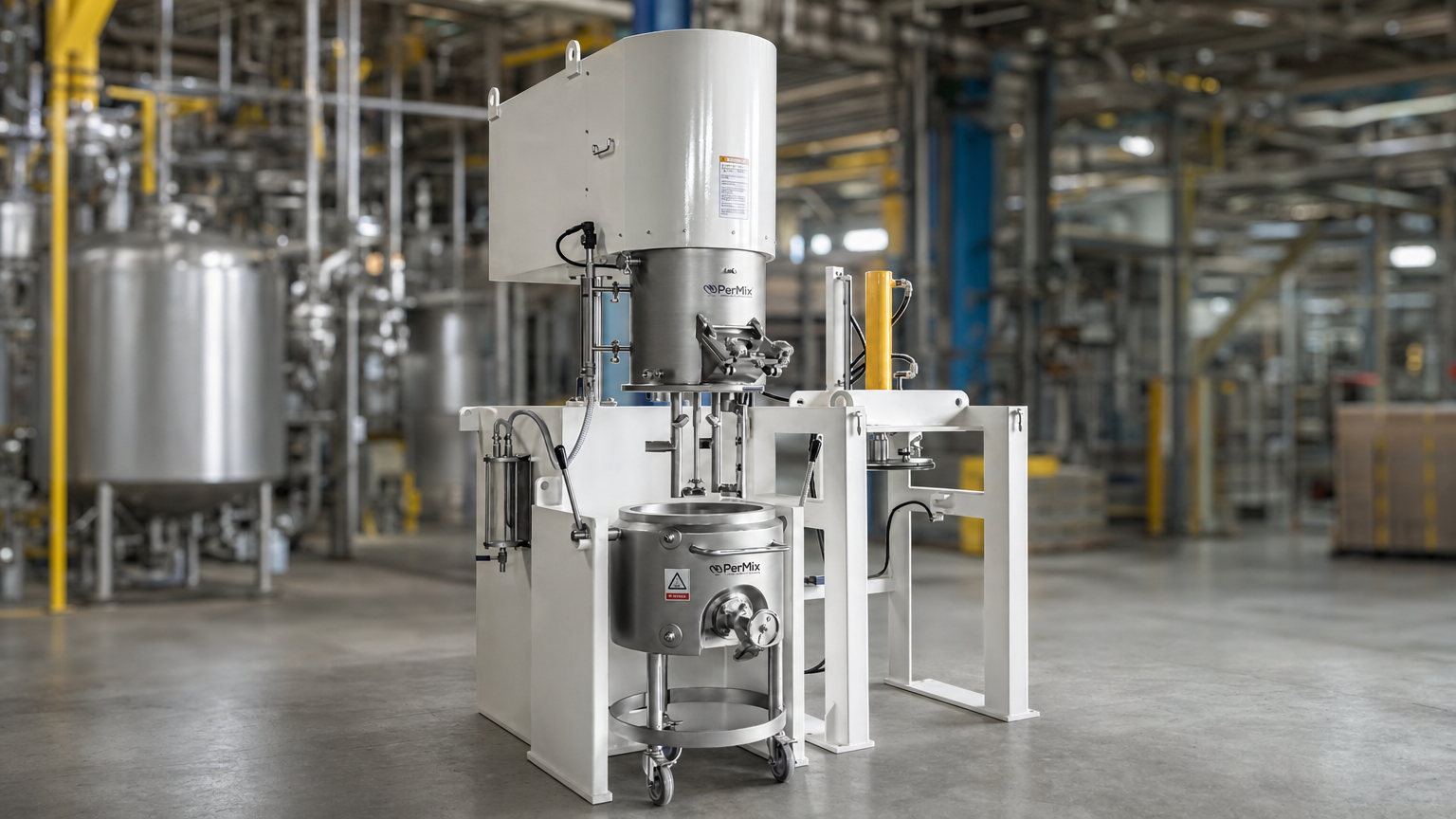
A double planetary mixer is an industrial paste mixer that uses two vertically mounted mixing tools. Each tool rotates on its own axis while both tools orbit a common central axis — the classic planetary motion. Process…
Double Planetary Mixer Guide for High-Viscosity Pastes and Kneading
A double planetary mixer is an industrial paste mixer that uses two vertically mounted mixing tools. Each tool rotates on its own axis while both tools orbit a common central axis — the classic planetary motion. Process engineers choose a double planetary mixer when viscosity is extremely high, dead zones are unacceptable, and standard high-speed dispersers or single anchors can no longer move the batch. This guide covers working principle, when to use a double planetary mixer, and how the PerMix PDP series fits high-viscosity production.
Industrial double planetary mixers are built for pastes, adhesives, sealants, composites, and other non-Newtonian products — not kitchen planetary stand mixers. The production machine in this category is the PerMix Double Planetary Mixer (PDP).
What is a double planetary mixer?
A double planetary mixer (sometimes called a double planetary kneader) processes materials that are too viscous for ordinary agitators yet still need distributive mixing and shear inside a vessel. Two blades sweep the entire bowl geometry: they spin individually and travel around the vessel center so every volume element is visited in a short cycle.
PerMix PDP double planetary mixers are engineered for extreme rheological profiles — including high-viscosity substances up to the order of 1,500,000 cPs — with high torque transmission through a robust gear drive. Intermeshing blade paths create high-pressure zones that help break agglomerates while the orbiting motion eliminates stagnant corners.
Compare with related paste equipment:
- PerMix Sigma Mixer — double-arm Z-blade kneading for heavy pastes and doughs
- PerMix High Speed Dispersion Mixer — tip-speed shear for lower-viscosity dispersions
- PerMix Multi-Shaft Mixer — combined high-speed and slow-speed tools in one tank
How does a double planetary mixer work?
Double planetary mixer working principle:
1. Two mixing tools mount vertically on a shared gear drive 2. Each tool rotates about its own axis (spin) 3. Both tools orbit the vessel center (revolution) 4. The combined path covers the full vessel cross-section, scraping and folding material continuously
That dual-action motion delivers intensive shearing and distributive mixing that a single central agitator cannot match in ultra-high viscosity. Because the tools sweep the internal circumference, wall film and bottom dead zones shrink — critical for non-Newtonian fluids that stop flowing once shear stress drops.
Optional discharge pistons and change-can designs help move finished paste out of the vessel when gravity discharge alone is impractical.
When to use a double planetary mixer
Specify a double planetary mixer when:
- Viscosity rises into ranges where disperser discs leave unmixed regions
- The product is past the flowable liquid stage but not suited to a heavy sigma kneader geometry
- Homogeneity and agglomerate breakdown must happen in one closed vessel
- Torque and gear strength matter more than tip speed alone
Prefer other designs when:
- The duty is mainly powder wetting into a low-viscosity liquid — start with a high shear / high speed disperser
- The product is a stiff dough or mass that fits sigma blade kneading better — see the Sigma mixer guide
- Dry powder blending is the goal — use ribbon, plow, paddle, conical, or tumble blenders from the products catalog
Applications
Common double planetary mixer applications include:
- Adhesives, sealants, and high-viscosity polymers
- Battery and specialty chemical pastes
- Pharmaceutical and cosmetic thick gels (when the machine is built to the required sanitary standard)
- Composite fillers and resin systems
- Food pastes that exceed ordinary agitator torque limits
Always match materials of construction, seals, and cleanability to the industry — PerMix configures each PDP around customer product and workflow, including lab-scale PDP units for scale-up.
How to specify a double planetary mixer
Document:
- Viscosity curve through the process (and peak torque demand)
- Batch size and fill level
- Need for vacuum, jacket temperature control, or inerting
- Discharge method (piston, change can, pumpable finish)
- Blade style and clearances for your solids loading
- Lab or pilot confirmation on a PDP before production scale-up
For broader selection across powder, paste, and liquid lines, read How to choose industrial mixers.
FAQ: double planetary mixer
What is the difference between a planetary mixer and a double planetary mixer?
Consumer “planetary” mixers usually have one beater that orbits. An industrial double planetary mixer uses two tools with spin-plus-orbit kinematics sized for high-viscosity production vessels.
Is a double planetary mixer the same as a sigma mixer?
No. A sigma (Z-blade) kneader uses horizontal double arms. A double planetary mixer uses vertical orbiting tools. Both handle high viscosity; geometry and discharge style differ — compare PerMix Sigma Mixer and PerMix Double Planetary Mixer.
Can double planetary mixers run under vacuum?
Many industrial planetary systems can be specified with vacuum covers for deaeration. Confirm vacuum capability on the configuration you order.
Next step
If your process needs a double planetary mixer for high-viscosity pastes, review the PerMix Double Planetary Mixer (PDP) and request application support. Explore more paste and powder machines at PerMix products.