Industrial Paint Mixer Guide: Paint Mixing Equipment from Dispersion to Sealants
· PerMix Team
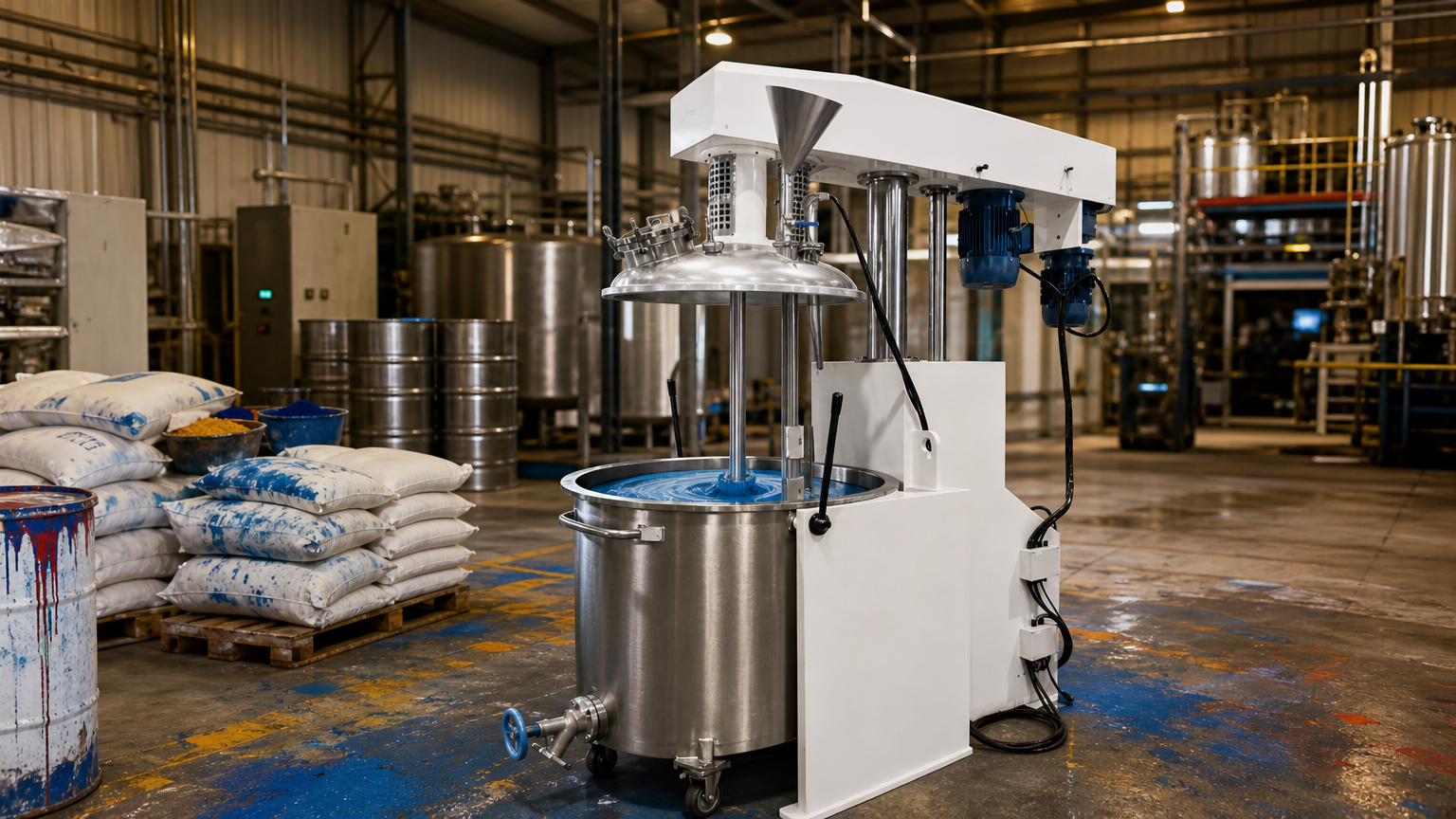
A production guide to industrial paint mixers: dry premix, high speed dispersion, inline shear, let down, ink, sealant and adhesive mixers, materials and ATEX, a selection checklist and common mistakes.
An industrial paint mixer is production equipment that wets, disperses and blends pigments, fillers, resins and solvents into a stable paint, coating, ink or sealant. A hand held paddle on a drill or a can shaker in a hardware store mixes paint that is already made. An industrial paint mixer makes the paint in the first place, and that is a very different job.
This guide looks at paint mixing equipment the way a production manager does. It covers the stages of paint manufacturing, which mixer machine fits each stage, what changes for inks, sealants and adhesives, the materials and ATEX details for solvent based work, and the mistakes that cost batches. Every machine named here is part of the PerMix range for paints and sealants.
What is an industrial paint mixer?
An industrial paint mixer, also called a paint mixer machine or paint dispersion machine, is a vessel with one or more mixing tools: a high speed saw disc, a slow anchor scraper, an inline rotor stator, or heavy kneading blades. It runs batches from a few liters in the lab up to several thousand liters in production.
The main jobs of paint mixing equipment are:
- Wetting powders such as pigments, titanium dioxide and fillers so the liquid vehicle surrounds each particle.
- Breaking up agglomerates so the paint reaches its target fineness, usually checked on a Hegman gauge, and develops full color strength.
- Stabilizing the dispersion with resins and additives so the pigment does not flocculate or settle.
- Letting down and adjusting viscosity, color and solids before filling.
Industrial paint mixing vs container and drum mixers
Search for a paint mixer and you will see 5-gallon pneumatic stirrers, drum mixers that clamp onto a barrel and container mixers for totes. These are useful tools in the paint and coatings industry, but they solve a different problem. They keep a paint or coating that is already made in a consistent state before use, for example by stirring a gallon can or a drum that has settled in storage. Manual stirring of large volumes is slow and gives a poor blend, so these tools save time on site.
Industrial paint mixing starts earlier. It is the production step where pigment, filler, resin and solvent become paint, and the consistency of every later batch depends on it. That application needs a custom design: the right disperser, vessel, scraper and drive for the formulation, sized for the batch, and a complete solution from premix to filling. That is the equipment this guide is about.
How paint is made: the stages that decide the mixer
Most paint and coating lines follow the same order, and each stage has its own mixer.
Dry phase: fillers and pigment premix
Powder fillers and pigments for tile adhesives, grouts, powder coatings and dry mix products are blended dry. The ribbon mixer (PRB) gives a 1:500,000 mixing ratio with a dual ribbon agitator. For more intensive work the paddle mixer (PTP) and plow mixer (PTS) reach ratios up to 1:1,000,000. The PTP handles pigments that tend to re agglomerate and uses less power than the plow mixer because it turns slower. Where speed matters, the fluidized zone mixer (PFBS) reaches a homogeneous mix in about 30 to 60 seconds, which helps protect heat sensitive organic pigments. A good dry premix shortens the time needed later in the dispersion stage.
Dispersion: the heart of paint making
This is where a paint mixer earns its keep. The high speed disperser (PD) uses a saw disc impeller that creates strong shear at its edge. The vortex pulls dry powder down into the shear zone, where agglomerates break apart. PerMix builds the PD from about 5 L lab units up to 8,000 L. Our high speed disperser guide explains disc size, tip speed and fill level in detail.
When viscosity rises, a single disperser shaft is not enough. The PD-2 dual shaft version adds a slow anchor scraper that keeps the whole batch turning over, and the PD-3 triple shaft version adds a screw or a second disperser for very high viscosity materials. Both can run under vacuum for air free products.
For inline processing, the shear pump (PCH) pumps and shears at the same time. It draws powders into the liquid stream without fish eyes, and PerMix rates it at about 90% less process time than a conventional agitator. When a finer particle size is needed, for high performance varnishes and inks, the inline emulsifier (PC) adds more shear. The inline mixer guide compares these two.
Let down, tinting and storage
After dispersion, resin, solvent or water and additives are added at lower speed to bring the paint to its final viscosity and color. This often happens in a separate let down or holding vessel with a slow agitator. See our mixing tank guide and the PerMix range of tanks and vessels for this stage.
Ink mixers, sealant mixers and adhesive mixers
Not every coating behaves like house paint. Viscosity is the main factor that moves you from one machine to another.
- Inks and varnishes. Low viscosity, very fine particle size. A high speed disperser for premix, followed by a shear pump or inline emulsifier, is a common ink mixer setup.
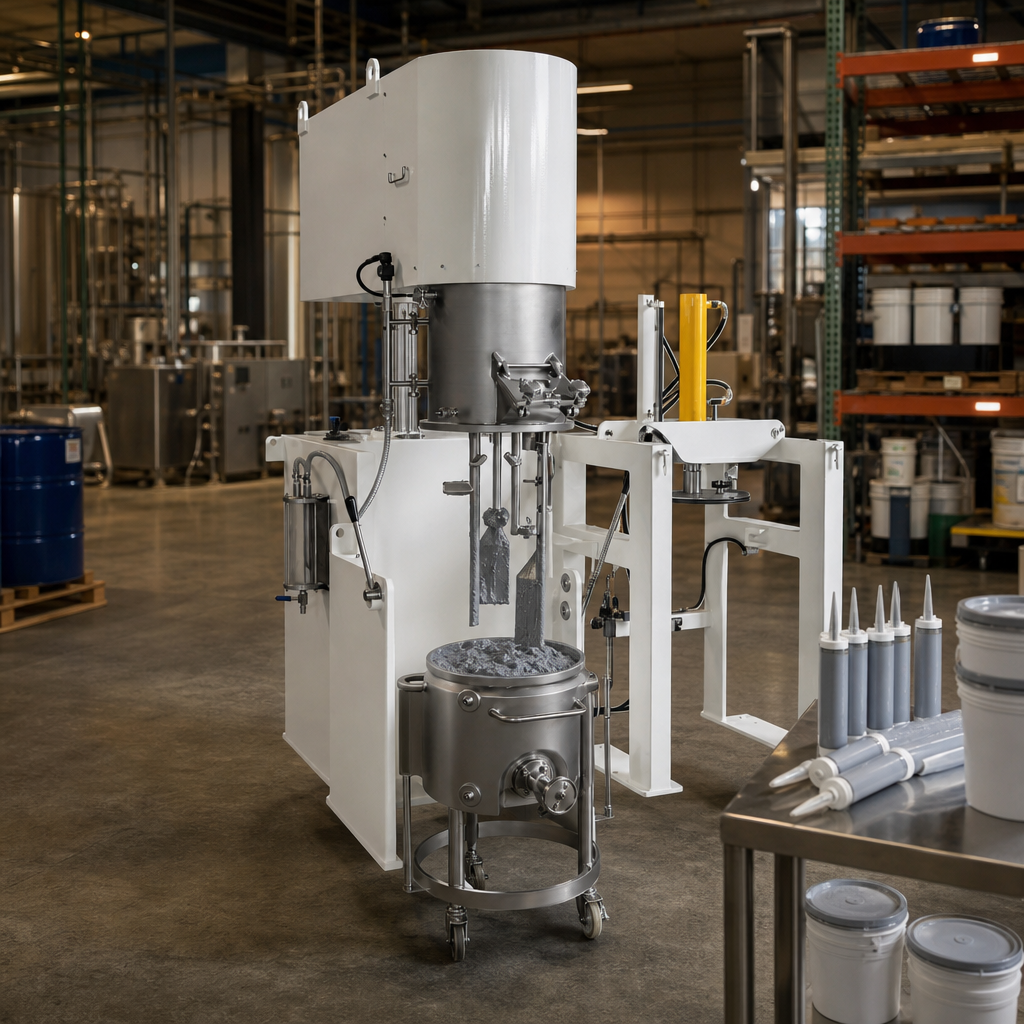
- Sealants, putty and fillers. Silicone, thiocol pastes and car body fillers need torque. The sigma mixer (PSG) with double Z blades handles viscosities above 500,000 cps. The PSG-X version adds an extrusion screw that can run in reverse during mixing to feed material back to the blades, then discharge it.
- Very thick mastics and sealants. The double planetary mixer (PDP) is rated up to 1,500,000 cps. Its two tools orbit the vessel while turning on their own axes, so shear thickening sealants do not climb the shafts. Read the double planetary mixer guide and the sigma mixer guide to compare them.
- Resins and adhesives. Trapped air creates bubbles that weaken a bond line. The vacuum deaerator (PDA), the multi shaft vacuum mixer (PMS) and the vacuum emulsifying mixer (PVC) remove air during or after mixing.
Materials, ATEX and safety in paint plants
Paint plants handle abrasive fillers, aggressive additives and often flammable solvents, so construction matters.
- Materials of construction. PerMix builds in SS304, SS316L, carbon steel, titanium, duplex stainless steel and Hastelloy. Hastelloy resists acidic catalyst additives, and duplex steel gives the strength needed for high pressure jacketed vessels. For abrasive fillers such as silica, tungsten carbide coatings reduce wear.
- Explosion protection. For solvent based paints, PerMix supplies ATEX and ExP configurations with non sparking seal designs and continuous grounding to prevent static discharge. Our article on ATEX vs ExP explains the difference.
- Seal position. On PerMix PNA and PVR vertical mixers the shaft seal and bearing sit above the working area, so they never touch the product.
If your plant also makes other chemical products, the chemical mixer guide covers the wider range.
How to choose paint mixing equipment
Answer these questions before you look at sizes:
- What viscosity range will the batch pass through, from premix to finished product?
- What fineness of grind and color strength must you reach, and how is it measured?
- Water based or solvent based? Does the area need ATEX or ExP?
- Batch size today and after growth, and how many colors or recipes per day?
- Do you need vacuum to remove air, or heating and cooling during mixing?
- Will powders be added from bags, big bags or an induction system?
A rule of thumb from projects we have built: low to medium viscosity paints and inks start with a PD high speed disperser. Rising viscosity or air sensitive products move to a PD-2 or PD-3 under vacuum. Thick sealants and putties go to the PSG or PDP. Continuous lines add a PCH or PC inline. The fastest way to confirm the choice is to run your own formulation at a PerMix test center.
Common mistakes in paint mixing
- Wrong disc size or fill level. A disperser disc that is too small for the vessel, or a batch that is too shallow, gives a weak vortex and long grind times.
- Adding powder too fast. Powder dumped on the surface floats and forms lumps. Add it into the vortex at a steady rate.
- Buying one machine for every viscosity. A disperser that is perfect for primer will stall on a sealant. Plan for the thickest product you will make.
- Ignoring air. Foam and micro bubbles cause surface defects in coatings and weak spots in adhesives. Vacuum or deaeration solves it.
- Forgetting heat. High shear warms the batch. Solvent loss and resin damage follow if the vessel has no cooling jacket.
FAQ
What is the best industrial paint mixer?
For most paints and inks it is a high speed disperser with a saw disc impeller. For higher viscosities a dual or triple shaft disperser with a scraper is better, and for sealants and putties a sigma or double planetary mixer.
What is the difference between a paint mixer and a paint shaker?
A paint shaker or a drill paddle remixes paint that is already made, often in a can. An industrial paint mixer manufactures the paint by dispersing pigments and fillers into the binder.
What machine is used to make sealant?
Sigma mixers and double planetary mixers are the most common sealant mixers, often under vacuum. PerMix rates its sigma mixer for viscosities above 500,000 cps and its double planetary mixer up to 1,500,000 cps.
Do I need an explosion proof paint mixer?
If you process flammable solvents, the area classification usually requires ATEX or ExP equipment. PerMix supplies both, with grounding and non sparking seals.
Can I test my paint formulation before buying a mixer?
Yes. PerMix runs trials with customer material at its test centers to confirm grind time, viscosity behavior and batch size.
Next step
Tell us your product, viscosity range and batch size, and our engineers will recommend the right paint mixing equipment. Request a quote.