V Blender Guide: Twin-Shell Tumble Mixing for Dry Powders
· PerMix Team
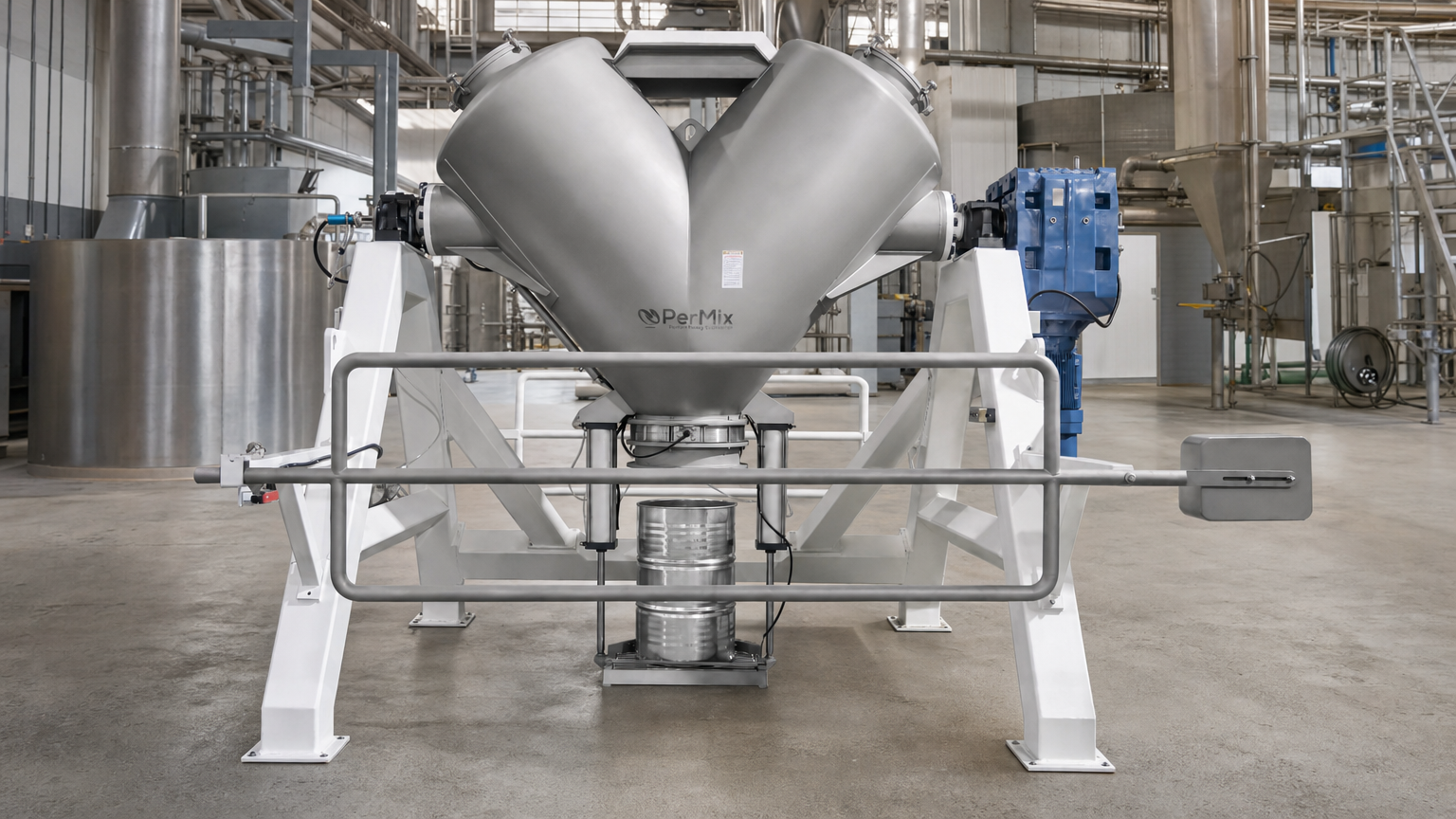
An industrial V blender (also called a vee blender or twin-shell tumble blender) gently mixes dry powders and granules by rotating a V-shaped vessel. This selection and working-principle guide clarifies process duty, fill level, and when to prefer ribbon or double-cone options.
This guide is about the industrial V blender — a twin-shell / vee blender tumble mixer for dry powders and granules on process lines. It is not a kitchen countertop blender and not related to consumer smoothie machines.
A V blender machine rotates a V-shaped vessel so powders cascade through the apex and split into the two legs, then reunite on the next turn. That tumble motion delivers gentle, low-shear blending when ingredients are free-flowing and particle sizes are reasonably compatible.
Product example: PerMix V-Blender.
What a V blender is (and is not)
In process engineering, a V blender (vee blender, V-type mixer, twin-shell blender) is a batch tumble blender. Two cylindrical shells meet at an angle to form a V. As the shell turns on trunnions, material repeatedly divides and recombines. Typical goals:
- Uniform mixing of dry powders and free-flowing granules
- Low shear relative to plow, paddle, or high-shear systems
- Clean discharge through a valve at the apex when the vessel is stopped in the unload position
- Batch genealogy for pharmaceutical, nutraceutical, food-ingredient, and specialty chemical premixes
Clarify intent in RFQs: buyers searching "v blender" sometimes mean consumer appliances. Specify industrial twin-shell / dry powder mixer capacity, metallurgy, and fill window so quotes stay process-relevant.
How V blenders work
Working principle is diffusion and convective cascading inside a rotating V shell:
1. Charge powders to the recommended fill fraction of working volume. 2. Close covers and interlocks; start rotation at the design speed band. 3. Material flows toward the apex, splits into both legs, then cascades back — promoting uniform mixing over a timed cycle. 4. Stop with the apex valve down; discharge the batch. 5. Clean per SOP before the next SKU.
Cycle time depends on recipe, particle-size distribution, and target coefficient of variation. Treat competitor "X minutes" claims as examples, not guarantees for your formula. Optional intensifier bars exist on some tumble designs for light agglomerate breakup — only specify them if the quoted model offers them and the product tolerates that energy.
When to use a V blender machine
Choose a V blender when:
- Powders and granules are free-flowing or only mildly cohesive
- Gentle handling matters more than aggressive de-lumping or wet granulation
- Batch sizes fit tumble-blender campaigns rather than continuous high-throughput trough lines
- Liquid addition is absent or very limited (tumble shells are not liquid-incorporation workhorses)
- Cleanability and sanitary finishes are part of the duty (food, pharma-adjacent, nutraceutical)
Industries that commonly evaluate V cone / twin-shell duty include pharmaceutical dry blends, vitamin and mineral premixes, food powders, and chemical additives where uniform mixing without particle damage is the priority.
V blender vs double cone, ribbon, and plow
Comparisons below use live PerMix pages only.
- Gentle twin-shell tumble for dry powders: PerMix V-Blender
- Twin conical tumble alternative: PerMix Double Cone Mixer
- Horizontal ribbon for broader powder/paste campaigns: PerMix Ribbon Mixer
- More aggressive convective / cohesive powder duty: PerMix Plow Mixer
- Still mapping geometries: How to choose industrial mixers
- Ribbon working principle deep dive: Ribbon mixer working principle
- Cone / double-cone selection: Cone mixer double cone blender guide
Double cone blenders share the tumble family with V blenders; geometry differs (two cones vs V-shell). Ribbon mixers use internal helical agitators in a trough and usually win on large campaigns, liquid spray addition, and plant standardization around horizontal blenders. Plow mixers fluidize denser or cohesive beds when tumble energy is not enough.
Advantages and limitations
Advantages of a well-specified V blender:
- Predictable gentle blend for free-flowing dry powders
- No internal ribbon to trap residue along a long trough
- Clear visual geometry and valve discharge at the apex
- Good fit for mid-scale batch powder mixing with hygiene requirements
Limitations to respect:
- Sticky, highly cohesive, or wet masses may bridge or fail to cascade
- Large liquid additions are better handled in ribbon, plow, or specialized paste equipment
- Very large continuous campaigns may prefer trough blenders for throughput and feeding integration
- Fill level is critical — overfill reduces freeboard for cascading; underfill can slow homogenization
Selection checklist for RFQs
Ask applications engineering for:
- Working volume vs total volume and recommended fill range
- Materials of construction and internal finish (Ra) for product contact
- Seal / bearing isolation strategy for fine powders
- Discharge valve type and estimated heel / residue
- Drive speed range, interlocks, and estimated mix time for your recipe class
- Optional intensifiers only if agglomerates must break without damaging primary particles
- Scale-up notes from pilot: same fill fraction and assay method, not RPM copied 1:1
Share bulk density, particle-size distribution, batch size, target uniformity, and cleaning requirements with the quote. Start from the live product page: PerMix V-Blender.
FAQ
What is a V blender used for?
Batch blending of dry, free-flowing powders and granules where low shear and uniform mixing matter — typical in pharmaceutical, nutraceutical, food-ingredient, and specialty chemical premixes.
How does a V cone blender work?
The V-shaped shell rotates so powder cascades through the apex and splits into both legs, repeatedly recombining the batch until the timed cycle ends.
Is a V blender the same as a kitchen blender?
No. An industrial V blender / twin-shell tumble blender is process equipment for powders. Consumer kitchen blenders are unrelated appliances.
V blender vs ribbon blender?
V = tumble shell, gentle cascade. Ribbon = internal helical agitator in a horizontal trough, often preferred for larger campaigns and modest liquid addition. See PerMix Ribbon Mixer.
V blender vs double cone blender?
Both are tumble blenders. Shell geometry differs; choose based on recipe, cleanability, and available capacities. Compare PerMix Double Cone Mixer.
Next step
Define duty first (materials, fill, CV target, hygiene), then confirm twin-shell tumble is the right geometry. Review capacities and options on PerMix V-Blender — or compare ribbon and double-cone pages if your process needs more agitation or a different tumble shape.