Conical Mixer Guide: How a Conical Screw Mixer Blends Powders Gently
· PerMix
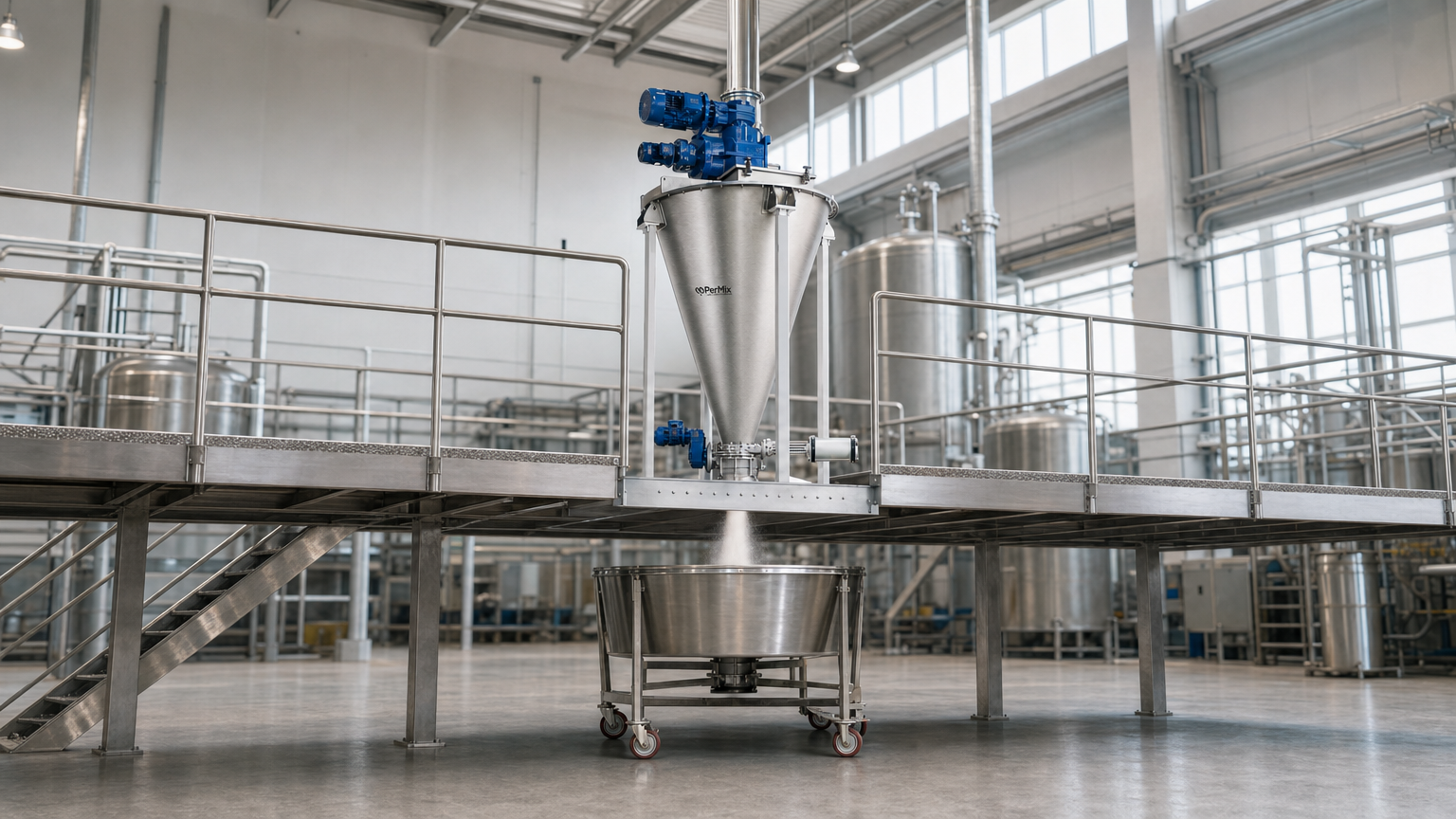
How a conical screw mixer works, when it beats a ribbon mixer, PNA sizes from 30 to 30,000 L and what to specify before you request a quote.
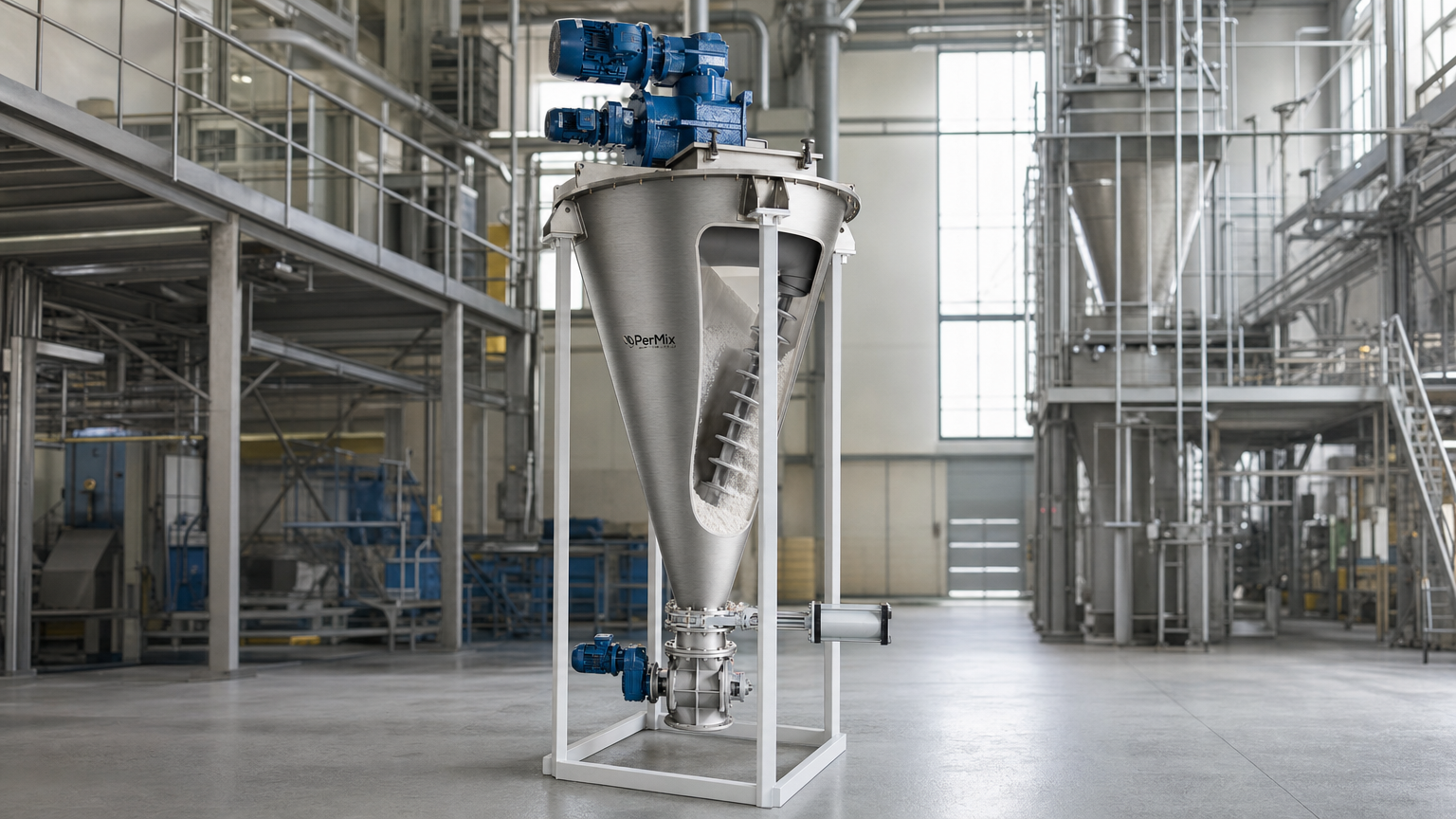
A conical mixer, more precisely a conical screw mixer, is a vertical batch mixer in which a screw agitator orbits inside an inverted cone, lifting powder from the bottom and letting it fall back by gravity. The result is gentle, low-shear mixing in three dimensions with very little heat, and almost complete discharge through the bottom discharge valve.
Process engineers choose this mixing equipment for mixing and blending powders that are fragile, heat sensitive or prone to segregation, and when every kilogram of a high value batch has to come out of the vessel. This guide explains how it works, when it beats a horizontal blender, and what to specify before you request a quote.
What is a conical screw mixer?
A conical screw mixer is a conical vessel shaped like an inverted cone, with one or more screws suspended from the top. The design is often called a Nauta type mixer, after the brand that popularized the orbiting screw principle. Inside the trade it is also described as an orbiting screw blender or vertical cone mixer.
The PerMix PNA series conical screw mixer has been used for more than 60 years as a standard for processing delicate, heat sensitive and segregation prone materials. It is built for applications that need minimal product distortion, high homogeneity, repeatable cycles and process validation.
Conical mixer vs double cone blender
The names sound alike, but the machines are different. A double cone blender has no internal agitator; the whole vessel tumbles. A conical screw mixer has a stationary vessel and a moving screw inside it. Tumble blenders suit free flowing granules. A conical screw mixer adds active convective flow and supports liquid addition, jacket heating and vacuum drying in a stationary vessel.
How does a conical screw mixer work?
The mixing principle combines two movements at the same time:
- The screw rotates on its own axis and lifts product from the bottom of the cone to the top.
- An orbital arm carries the screw around the periphery of the vessel, so the screw stays parallel to and close to the cone wall.
- At the top, gravity takes over and the material falls back toward the center and the bottom.
- The continuous lift and fall creates a convective flow that reaches every zone of the cone.
This planetary movement is what gives true three dimensional, convective mixing. Material is displaced axially along the screw by its pitch and moved radially and around the vessel by the orbit, so no region of the batch is left out. The outcome is uniform mixing without the aggressive action of high shear mixing technology.
Why the conical shape matters
The conical geometry is self draining. With no supports, bearings or mechanical obstructions at the bottom, product flows out through the discharge valve for complete discharge and near complete emptying of the vessel. For expensive actives, flavors or specialty chemicals, that difference in yield is often what pays for the mixer. An empty vessel also means easy cleaning and less risk of cross-contamination between batches.
Key benefits: when to choose a conical mixer over a ribbon mixer
A ribbon mixer is the right tool for many general powder blends. The PNA conical screw mixer is selected over horizontal alternatives when specific process drivers apply:
- Material sensitivity. The gentle lifting action prevents product degradation and avoids the heat generation common in high shear mixers, so fragile or friction sensitive products keep their structure.
- Energy efficiency. Gravity generates a large share of the downward mass flow, so the PNA needs less motor power than horizontal mixers of comparable volume. That makes it an energy-efficient mixing system for large batches.
- Hygiene and contamination control. The top driven design places all shaft seals and bearings above the product zone, which eliminates the risk of lubricant contact with the batch.
- Anti segregation. The screw continuously moves material against the natural path of gravity driven settling, which helps products that tend to separate by density or particle size.
- Product recovery. The self draining cone gives near complete discharge of high value batches.
Conical screw mixer design and construction
Cantilevered screw
The defining feature is the cantilevered screw. It is supported only from the top by the orbital arm, so there is no bottom bearing inside the product. Because the cantilevered design has to manage high torque and bending moments when the mixer starts under full load, the top assembly uses precision balanced load bearing components.
Screw configurations
PerMix supplies single, double or triple screw configurations to match the mixing intensity of the application.
Materials of construction
Contact parts can be built from carbon steel, SS304, SS316 or SS316L, titanium, duplex stainless steel and Hastelloy. Titanium and Hastelloy are recommended for highly corrosive halides that would pit standard stainless steel. For abrasive products, mixing elements can be hardened with tungsten carbide.
Options: liquid addition, heating, vacuum drying and more
The PNA series can be configured well beyond dry blending:
- Spray nozzles for powder moistening or coating during the cycle.
- Jacketed vessels for temperature control, heating or cooling with steam, thermal oil or water, with ASME or PED certificates available for pressure duty. Vacuum or pressure execution and CIP or WIP cleaning concepts can be included where required.
- Vacuum operation, so the PNA can work as a vacuum mixer dryer or deaerate slurries. Vacuum processing helps prevent oxidation of sensitive organic compounds and speeds up low temperature drying.
- A flush fitting sampling unit for QC and process validation.
- Lifting and lowering of the top assembly and screw to make cleaning and maintenance easier.
- Laboratory and R&D sizes of about 8 L working volume on casters for mobility and manual dismantling.
If drying is the main duty rather than an option, compare the PNA with the dedicated PerMix vacuum mixer dryer range.
Typical applications
- Pharmaceutical and bio: gentle blending of dry powders and active pharmaceutical ingredients where crystalline structure must be preserved.
- Food and nutraceutical: dietary supplements, protein powders and infant formulas.
- Chemical and plastics: pigments, plastic additives and minerals.
- Metals and minerals: metal powders and abrasive mineral compounds.
Process duties include gentle mixing of free flowing and fine powders, flakes and granules; coating and moistening; granulation with binders; and vacuum drying of wet powders and slurries with liquid recovery. Across all of them, the same powder mixing principle applies: lift, orbit and fall.
Conical mixer sizes and scale-up
The standard PNA range runs from the PNA-30 to the PNA-30000. A few reference points from the PerMix specification table:
- PNA-30: total volume 30 L, working volume 3 to 18 L, screw power 0.75 kW, orbit power 0.18 kW.
- PNA-500: total volume 500 L, working volume 50 to 300 L, screw power 3 kW, orbit power 0.55 kW.
- PNA-2000: total volume 2,000 L, working volume 200 to 1,200 L, screw power 5.5 kW, orbit power 0.55 kW.
- PNA-10000: total volume 10,000 L, working volume 1,000 to 6,000 L, screw power 22 kW, orbit power 3 kW.
- PNA-30000: total volume 30,000 L, working volume 3,000 to 18,000 L, screw power 45 kW, orbit power 7.5 kW.
Note how wide the working volume range is. A conical screw mixer can run a batch as small as about 10 percent of total volume, which makes it practical for plants with variable batch sizes. When scaling up, engineers adjust screw speed and orbital arm speed relative to the vessel diameter to keep homogeneity and mixing times consistent. Power figures depend on the product.
How to choose the right conical mixer: specification checklist
PerMix engineers translate your process parameters into the machine design, so the more of these you share, the better the batch mixing result:
- Products to be mixed, bulk density, particle size range and any fragile or heat sensitive components.
- Minimum and maximum batch size, so the working volume range fits your production.
- Liquid additions, coating or granulation steps.
- Heating, cooling, vacuum drying or deaeration requirements.
- Cleaning regime, hygiene class and validation needs, including sampling.
- Material of construction, corrosion and abrasion risks.
- Upstream feeding. If raw materials arrive caked or compacted, a lump breaker ahead of the mixer prevents hard lumps from sitting in the batch.
FAQ: conical mixers
What is a conical mixer used for?
A conical mixer is used for gentle, homogeneous blending of powders, granules and flakes, especially fragile, heat sensitive or segregation prone products in pharma, food, nutraceutical, chemical and mineral plants. It is an efficient mixing process for products that would degrade in a high shear machine.
Is a conical mixer the same as a Nauta mixer?
In everyday use, yes. Nauta mixer is a common name for the orbiting screw conical mixer. Technically, a conical screw mixer uses a screw that orbits inside a stationary cone.
How does a conical screw mixer differ from a ribbon blender?
A ribbon blender is horizontal and moves product with helical ribbons along a trough. A conical screw mixer is vertical, uses gravity for part of the flow, keeps seals above the product and discharges almost completely from the cone.
Can a conical screw mixer dry products?
Yes. With a heating jacket and vacuum execution, the PNA can work as a vacuum mixer dryer for wet powders and slurries, with liquid recovery.
What is the minimum batch in a conical screw mixer?
The PNA working volume starts at about 10 percent of total volume. For example, the PNA-1000 has a working range of 100 to 600 L.
Does a conical mixer generate heat?
Very little. The low shear lifting action avoids the frictional heat common in high shear mixers, which is why it is chosen for heat sensitive products.
Get a PerMix conical screw mixer specified for your process
PerMix has engineered industrial mixers since 1954 and builds them from lab scale to 30,000 L. Bench, pilot and production scale machines are available for trials at PerMix labs or shipped to your site. Share your recipe, batch range and process steps, and a PerMix engineer will recommend the right PNA configuration.