Plow Mixer Guide: Plowshare Mixing for Cohesive Powders
· PerMix Team
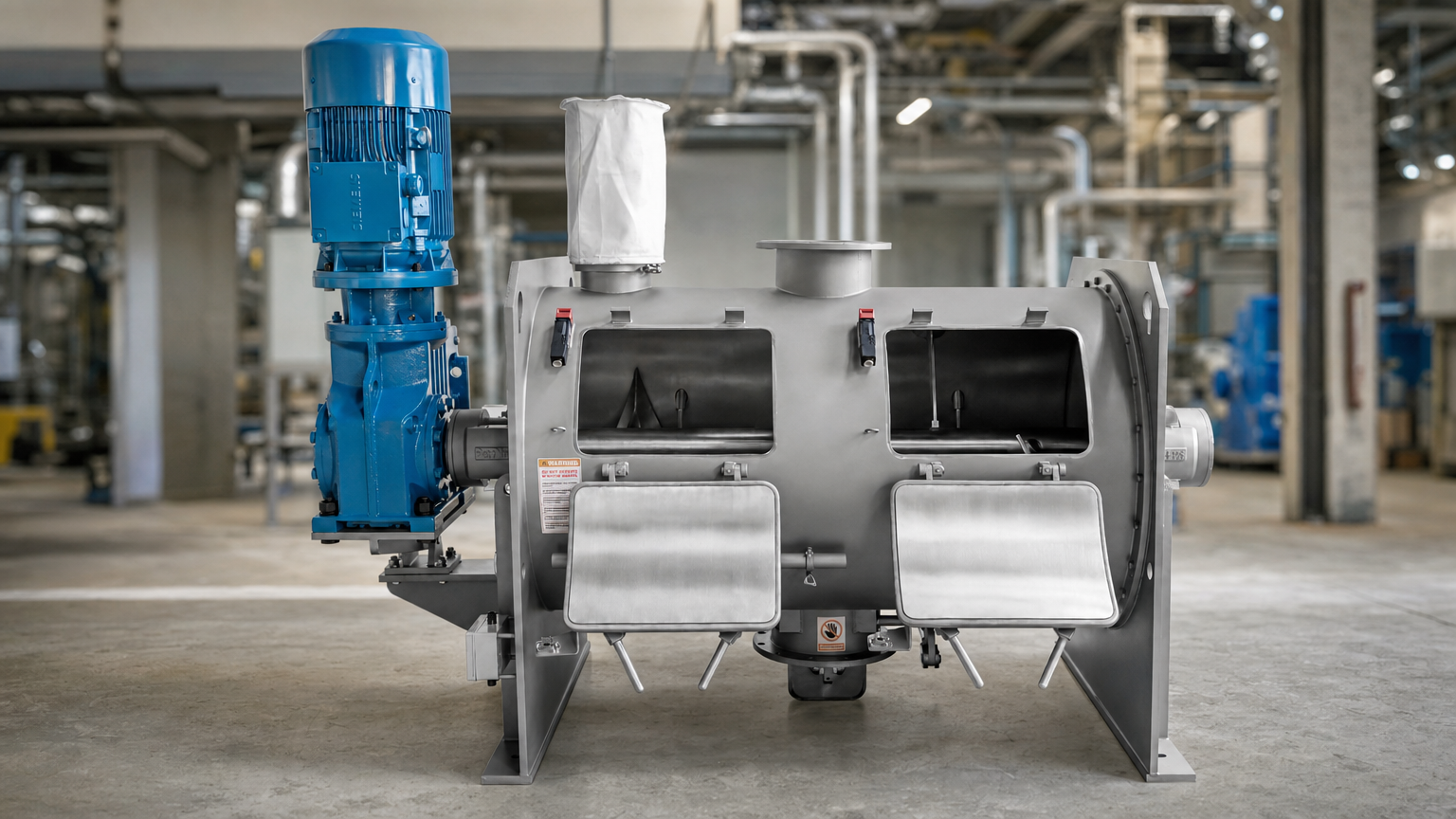
A plow mixer (plowshare mixer / ploughshare mixer / plow blender) uses plow-shaped shovels on a horizontal shaft to lift and fluidize powders, creating fast convective mixing for cohesive, dense, or liquid-added…
A plow mixer (plowshare mixer / ploughshare mixer / plow blender) uses plow-shaped shovels on a horizontal shaft to lift and fluidize powders, creating fast convective mixing for cohesive, dense, or liquid-added recipes. It is a standard industrial powder mixer geometry — not a farm tillage tool.
PerMix manufactures plow mixers for process plants that need more aggressive bed motion than a gentle ribbon or paddle. Product page: PerMix Plow Mixer.
What a plow mixer is
In process engineering, a plow mixer is a horizontal batch mixer. Plow elements rotate through the powder bed, throwing material into a mechanically fluidized state so ingredients redistribute quickly. Typical goals:
- Fast mixing of cohesive or fine powders that channel in low-energy blenders
- Incorporation of liquids or pastes into powders with optional choppers
- Shorter mix times on dense formulations versus gentle tumble equipment
- Batch genealogy for food, chemical, construction-material, and specialty powder campaigns
Search variants include plow mixer, plowshare mixer, ploughshare mixer, and plow blender. Specify working volume, choppers, and liquid addition when you RFQ so quotes stay comparable.
How plowshare mixers work
Working principle is mechanical fluidization:
1. Charge powders to the recommended fill fraction of working volume. 2. Start the shaft so plow shovels lift and throw the bed into a fluidized zone. 3. Optional high-speed choppers break lumps or distribute liquids sprayed into the bed. 4. Run the timed cycle until uniformity (assay / CV) meets the release target. 5. Discharge through a bottom valve; clean per SOP before the next SKU.
Tip: fill level and chopper use matter as much as shaft RPM. Overfill kills freeboard for fluidization; underfill can leave walls unwetted. Treat brochure "X minute" claims as examples for your recipe class, not guarantees.
When to use a plow mixer
Choose a plow mixer when:
- Powders are cohesive, fine, or tend to form soft agglomerates
- You need faster homogenization than a low-intensity ribbon alone can deliver
- Liquid addition or light granulation with choppers is part of the duty
- Batch sizes fit horizontal plow campaigns rather than continuous trains
- Heat and attrition from higher energy are acceptable for the product
Gentler alternatives (V blender, double cone, light ribbon fills) fit free-flowing, fragile, or low-energy dry blends better.
Related PerMix pages:
- Plow / plowshare duty: PerMix Plow Mixer
- Related fluidized-zone geometry: PerMix Fluidized Zone Mixer
- Horizontal ribbon alternative: PerMix Ribbon Mixer
- Vertical ribbon for footprint-sensitive sites: PerMix Vertical Ribbon Mixer
- Paddle convection: PerMix Paddle Mixer
- Selection overview: How to choose industrial mixers
Plow mixer vs ribbon, paddle, and tumble blenders
Comparisons use live PerMix pages only.
- Aggressive powder fluidization: PerMix Plow Mixer
- Broad powder/paste ribbon campaigns: PerMix Ribbon Mixer
- Ribbon working principle: Ribbon mixer working principle
- Gentler paddle motion: PerMix Paddle Mixer
- Twin-shell tumble for free-flowing dry powders: PerMix V-Blender
- Double-cone tumble: Cone mixer double cone blender guide
Ribbon mixers often win as plant standards for moderate cohesion and liquid spray. Plow mixers win when the bed needs mechanical fluidization and choppers. Tumble blenders win when shear must stay very low.
Advantages and limitations
Advantages of a well-specified plow mixer:
- Fast convective mixing in a fluidized powder bed
- Strong option for cohesive powders and many liquid-addition recipes
- Choppers available on suitable models for lump breaking
- Familiar horizontal batch layout for discharge and cleaning SOPs
Limitations to respect:
- Higher mechanical energy can attrit fragile particles
- Heat generation may matter for sensitive actives
- Not the first choice for ultra-gentle free-flowing tumble duty
- Continuous high-tonnage campaigns may prefer a continuous mixer instead
Selection checklist for RFQs
Ask applications engineering for:
- Working volume vs total volume and recommended fill range
- Plow tip speed / shaft speed band and drive power
- Chopper count, speed, and when they are recommended
- Liquid addition (spray bars, rates) if wetting or light granulation is required
- Materials of construction and internal finish for product contact
- Seal and bearing isolation for fine or abrasive powders
- Discharge valve type and expected heel
- Scale-up notes from pilot: same fill fraction and assay method
Share bulk density, cohesion, particle-size distribution, liquid %, batch size, and cleaning requirements with the quote. Start from the live product page: PerMix Plow Mixer.
Construction and options buyers ask about
Industrial plow mixer equipment is commonly quoted in stainless steel for food, chemical, and cosmetic powder duty; carbon steel may appear on abrasive or non-sanitary campaigns. A jacket can support heating or cooling when the process needs temperature control. Choppers (high-speed) are optional. Confirm horizontal plow blender geometry, working liters, and whether you need a dryer-capable plow configuration — only if that option is on the quoted model.
Search variants to include in RFQs: plow mixer, ploughshare mixer, plowshare mixer, and plow blender. PerMix is one manufacturer in this industrial mixing category; compare paddle mixer alternatives when gentler motion is enough.
Industrial plow mixer equipment details
An industrial plow mixer is process equipment for powder applications across chemical, food, and cosmetic industry plants. Buyers often specify stainless steel (including 304 stainless steel) contact parts, sometimes with a jacket for heating or cooling. The machine may be sized in liters of working volume. PerMix is a manufacturer of plow mixer and plow blender systems; evaluate paddle mixer alternatives when a gentler blend is enough.
Used plow mixers appear on secondary markets, but a new industrial mixer quote should still cover seals, discharge, and choppers. Horizontal plowshare / ploughshare geometry remains the core. Some campaigns ask about dryer-capable jackets — only order that if the manufacturer lists it for your application.
Sanitary and process engineering notes
Pharmaceutical packaging and sanitary food applications often require stainless steel vessels and stainless steel contact surfaces, careful seal design, and documented discharge. Engineers may add vacuum jackets or heating jackets when the process needs degassing or temperature control. Packaging lines after the plow mixer vessel benefit from predictable discharge and low heel. Specify chopper use, seal type, and sanitary finish in the engineer package so the manufacturer sizes the machine correctly for your industry application.
FAQ
What is a plow mixer used for?
Batch mixing of powders — especially cohesive or liquid-added formulations — where plow shovels fluidize the bed for fast, uniform mixing.
Plow mixer vs ploughshare mixer?
Same equipment family. Spelling varies by region (plow / plough / plowshare / ploughshare). Specify capacity and choppers in the RFQ.
Plow mixer vs ribbon mixer?
Plow = mechanical fluidization with shovels; ribbon = helical agitator in a trough. Plow is often more aggressive; ribbon is a common general-purpose powder blender. Compare PerMix Ribbon Mixer.
Do I need choppers?
Only if lumps must break or liquids need intense local distribution. Ask applications engineering — do not assume every plow quote includes choppers.
Next step
Define duty first (cohesion, liquid addition, CV, heat/attrition limits), then confirm plow geometry fits. Review options on PerMix Plow Mixer — or compare ribbon, paddle, and fluidized-zone pages if energy level needs tuning.