High Viscosity Mixer Guide: How to Choose a Mixer for Pastes and Viscous Products
· PerMix Team
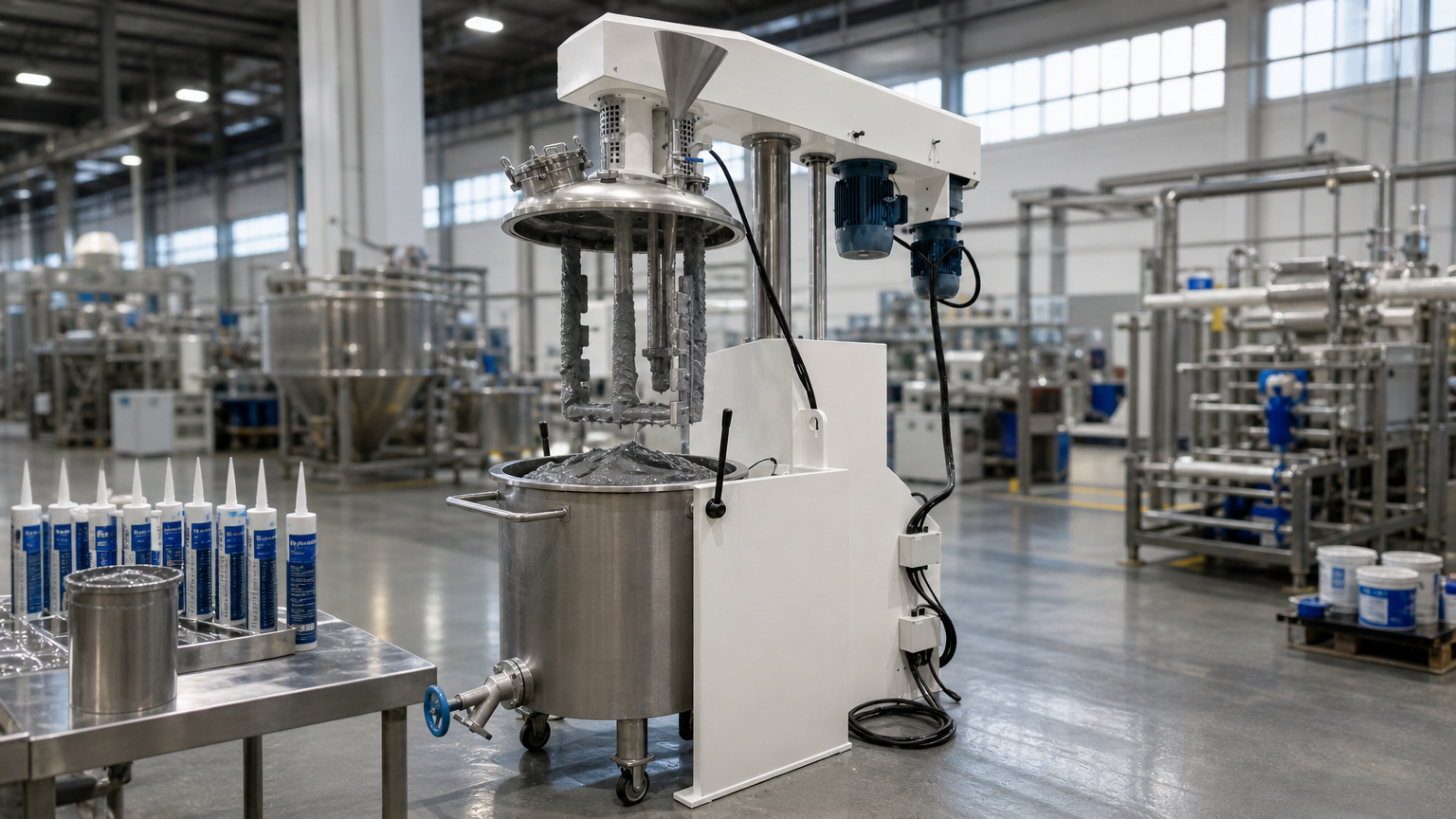
What changes when viscosity rises, why one shaft is rarely enough, and how to choose between dual and triple shaft, multi-shaft vacuum, double planetary, sigma, vacuum emulsifying and contra-rotating mixers for creams, gels, sealants and pastes.
A high viscosity mixer is a machine built to move and mix products that resist flow and are hard to mix with ordinary equipment: creams, gels, sealants, adhesives, pastes, doughs, fillings and heavily filled slurries. These products do not swirl like water. They climb the shaft, stick to the vessel wall, trap air and heat up from friction, so you cannot simply mix them faster. A standard agitator or impeller that works well on low viscosity liquids will often just carve a hole in a thick paste while the rest of the batch sits still. That is why high-viscosity mixing needs specialized equipment and a different mixer design.
This guide explains what changes in the mixing process when viscosity rises, the main types of high viscosity mixers, and how to match a mixer to your product and formulation. It is written for process engineers and plant managers who need a practical answer, not a theory lesson.
What makes high viscosity mixing different?
Viscosity is a product's resistance to flow, usually measured in centipoise (cP). Water is about 1 cP. Many creams, gels and pastes run into the tens or hundreds of thousands of cP, and some kneaded masses go well beyond that. As viscosity increases, four things happen in the mix vessel:
- Flow becomes laminar. The product stops tumbling on its own, so it will not mix itself between blade passes. Material only moves where a blade physically pushes it, so blade coverage of the whole vessel matters more than speed.
- Torque climbs. The motor has to push the full mass, not just stir it. Undersized drives stall or overheat.
- Heat builds up. Friction warms the batch, and thick product does not carry heat away from the wall on its own. Without scraping and a jacket, the product near the wall scorches while the core stays cool.
- Air gets trapped. Bubbles cannot rise out of a thick paste, which hurts appearance, density, shelf life and filling accuracy.
A good high-viscosity mixer answers all four: it covers the whole vessel, has high torque, scrapes the wall for heat transfer, and usually runs under vacuum. Liquid mixing equipment, like a propeller in one of the usual mixing tanks, is not built for that load.
Why one shaft is rarely enough
In a single shaft mixer, a viscous material often rotates with the blade as one solid plug. The product right at the blade moves, but the material near the wall and at the bottom becomes a dead zone. Agitation alone does not mix it. This is why high viscosity mixing applications use two or more blades, often on different shafts and at different speeds, to get uniform mixing:
- A slow anchor or wall scraper turns the whole mass and keeps the vessel wall clean.
- A faster element (paddle, screw, disperser blade or homogenizer) works the product the anchor feeds into it.
- On some machines, the tools also move around the vessel, so they reach every point.
The result is a mixing action that can blend, disperse and knead highly viscous products that would never move easily when agitated by a single impeller.
Types of high viscosity mixers
PerMix groups these machines as paste mixers: vacuum, multi-shaft, planetary, sigma and dispersion mixers. Each fits a different range of viscosity and a different kind of product, and together they cover most industrial mixing needs for higher viscosities.
Dual shaft and triple shaft mixers
A dual shaft mixer pairs a high speed disperser blade with a slow anchor scraper. The anchor turns the batch over and scrapes the wall, and the disperser shears the material that the anchor feeds into it. A triple shaft mixer adds a third tool, usually a rotor stator homogenizer, for finer emulsions or dispersions.
The PerMix PD-2 (dual shaft) and PD-3 (triple shaft) versions of the dual shaft mixer are vacuum-rated for air-free product, with heating and cooling jackets, hydraulic lifting of the top assembly for cleaning, and sampling units that work without breaking vacuum. The standard single shaft PD disperser is the economical choice for low to medium viscosity, and you step up to PD-2 or PD-3 when the product gets thick, for example in the blending of heavy paints or primers in the coatings industry.
Multi-shaft vacuum mixers
The PerMix PMS multi-shaft mixer is a universal system for products whose viscosity changes a lot during the batch. A typical setup has a perimeter anchor with PTFE scrapers, a slow paddle or screw for bulk movement, and a high speed disperser, each with its own drive, so operators can run specific agitators at specific stages of the recipe.
The vessel is vacuum-rated for continuous deaeration, standard construction is SS316L, and the drive is top-mounted so shaft seals and bearings stay above the product. Typical products include sunscreen, creams, toothpaste, ointments, mayonnaise, chocolate fillings, silicone pastes, adhesives and battery slurry. Multi-shaft mixers are a good fit when one line has to cover a wide range of formulations.
Double planetary mixers
In a double planetary mixer, two vertical tools rotate on their own axes while orbiting the center of the vessel. Over a short time the tools pass through every point in the batch, so there are no dead zones even in very heavy products.
The PerMix PDP double planetary mixer handles products up to 1,500,000 cP. Because the tools enter from the top, there are no submerged seals in the product zone. Options include vacuum, internal wall scrapers, finger, twist or butterfly blades, and a third high speed disperser shaft. It is widely used for adhesives, sealants, printing inks, fillers, confectionery masses, dental composites, greases and battery electrode slurries. Our double planetary mixer guide goes deeper into how it works.
Sigma mixers and kneaders
When a material becomes too stiff to flow at all, you need a kneader. The PerMix PSG sigma mixer uses two Z-shaped blades in a W-shaped trough, turning at a 3:2 speed ratio to compress, stretch, fold and shear the mass. It is built for materials above 500,000 cP, such as gum base, heavy doughs, rubber compounds, butyl sealants, mastics, putties and pigment concentrates. The PSG-X version adds an extrusion screw for discharge. See our sigma mixer guide for selection details.
Vacuum emulsifying mixers and contra-rotating mixers
For viscous emulsions such as creams, ointments, mayonnaise and dressings, the main goal is a stable, air-free emulsion rather than raw kneading power. The PerMix PVC vacuum emulsifying mixer combines an anchor with PTFE scrapers, a bottom-entry homogenizer and a jacketed vacuum vessel, in sizes from PVC-10 to PVC-2000. Our vacuum mixer article explains when vacuum pays off.
For gels and creams where wall heat transfer is critical, the PerMix PCR contra-rotating mixer turns an outer scraping anchor and inner turbine paddles in opposite directions, which breaks up the rotating plug that forms in single shaft mixers.
How to choose a high viscosity mixer
Mixer selection starts with the product's highest viscosity during the batch, not its starting viscosity. Work through these questions.
- How thick does it get? As a rough map of the PerMix range: the PC inline emulsifier handles up to about 10,000 cP with a variable speed drive. Dual shaft, triple shaft, multi-shaft, contra-rotating and vacuum emulsifying mixers cover creams, gels and pastes. The double planetary mixer goes up to 1,500,000 cP, and the sigma mixer is built for masses above 500,000 cP that need kneading.
- Is it an emulsion, a dispersion or a dough? What you need to mix decides the tools. Emulsions need a homogenizer. Powder-heavy dispersions need a disperser blade. Stiff doughs and putties need kneading.
- Does air matter? For cosmetics, ointments, sealants and anything filled by volume, choose vacuum execution.
- How sensitive is it to heat? Heat-sensitive products need wall scrapers and a jacket. Remember that friction in thick products adds heat on its own.
- How will you discharge it? Thick pastes do not drain. Look at tilting troughs, extrusion screws, hydraulic lift with removable vessels, or bottom valves sized for paste.
- How many recipes? If one machine must run thin and thick products, a multi-shaft design with independent drives gives the most flexibility.
- Scale-up. Test on a lab or pilot unit with the same geometry. PerMix scales these machines on tip speed and heat transfer, not just volume.
Common mistakes in high viscosity mixing
- Buying on starting viscosity and stalling when the batch thickens.
- Using a high speed disperser alone on a thick product, so it cavitates in a hole while the rest of the batch does not move.
- Skipping wall scrapers, then fighting scorched product and long cooling times.
- Ignoring air until the filling line shows weight variation.
- Treating viscous mixing as a speed problem. More rpm on the wrong tool rarely helps; more coverage and the right mixing equipment do.
FAQ
What is the best mixer for high viscosity products?
There is no single best mixer. For creams and gels, a multi-shaft or vacuum emulsifying mixer is usually right. For very heavy pastes, a double planetary mixer. For stiff doughs and putties, a sigma mixer.
What is a dual shaft mixer used for?
A dual shaft mixer combines a high speed disperser with a slow anchor scraper. It is used to mix viscous dispersions such as coatings, adhesives, sealants and cosmetic creams that are too thick for a disperser alone.
Can a high shear mixer handle high viscosity?
On its own, only up to a point. Rotor stator heads work best when an anchor or other slow agitator keeps feeding product into them, which is how multi-shaft and vacuum emulsifying mixers are built.
Is a planetary mixer good for high viscosity mixing?
Yes. Because the tools orbit through the whole vessel, a double planetary mixer is one of the most reliable designs for very viscous pastes.
Where does a liquid mixer stop and a paste mixer start?
When the product stops flowing toward the blades on its own, and a propeller can no longer mix the whole batch, you are in paste mixer territory. These high viscosity mixtures need different mixing technologies. For thinner products, see our liquid mixer guide.
Talk to PerMix about your viscous product
PerMix builds high viscosity mixers from lab sizes to production lines. Send your product, viscosity range and batch size through the contact page and we will suggest a setup.