Liquid Mixer Guide: Types of Industrial Liquid Mixers and How to Choose
· PerMix Team
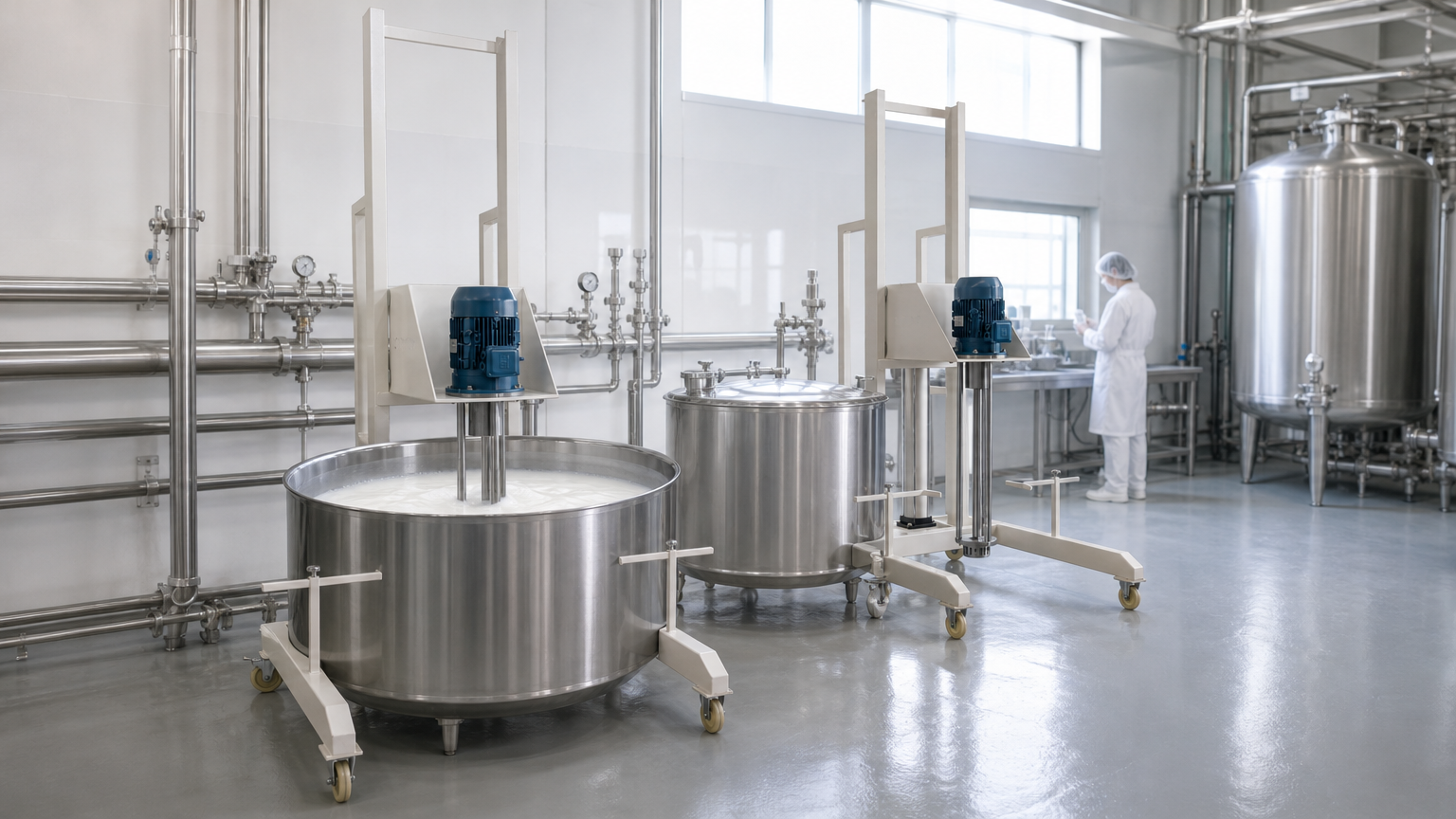
A production guide to industrial liquid mixers: batch high shear mixers, inline emulsifiers, powder induction mixers and shear pumps, contra-rotating mixers, magnetic mixers, dispersers and mixing tanks, with inline vs in-tank advice and a selection checklist.
A liquid mixer is any machine that moves, blends, disperses or emulsifies a product whose base is a liquid: syrups, sauces, dairy blends, shampoos, lotions, detergents, coatings and pharmaceutical solutions. In a plant, the right liquid mixer is chosen by three things: how thick the product is, what has to go into it (oil, powder, gum, air-sensitive actives), and whether you mix in a tank or in a pipeline. This guide explains the main types of industrial liquid mixers, what each one does well, and how to pick one without overbuying.
A quick note on search intent. If you are looking for a handheld drink mixer, a coffee frother, an electric whisk or an immersion blender for the kitchen, this is not that kind of guide. Those tools are fine for a glass or a bowl. Here we are talking about liquid mixing equipment and the industrial mixer machine options for batches from a few liters in a lab to thousands of liters on a production line.
Liquid mixer vs lab stirrer and kitchen mixers
In a lab, a magnetic stir plate, a lab vortex or an overhead stirrer is usually enough to mix a beaker or a few liters while you develop a formula. A lab mixer like that gives you speed control and lets you note the mixing speed and torque, which is useful data later. It does not tell you how the same product behaves in a 2,000 liter tank, where heat, air and dead zones behave differently.
An industrial liquid mixer is a heavy duty machine built for repeatable production processes: stainless steel contact parts, variable speed drives, sealed shafts or seal-less drives, jackets for temperature and a design that can be cleaned in place. Choosing the right one early saves you from scaling up a formula that only works on the bench.
What is liquid mixing?
Liquid mixing is the process of making a liquid batch uniform. Depending on the product, that can mean five different jobs:
- Blending: two or more miscible liquids become one consistent mixture, for example a syrup with flavor and color.
- Dissolving and suspending: solids go into solution, or stay evenly suspended without settling.
- Dispersing: powders such as gums, starches, pigments and fillers are wetted and broken down without lumps.
- Emulsifying: oil and water phases are sheared into small, stable droplets, as in creams, dressings and lotions.
- Heat transfer: the batch is heated or cooled evenly while it is being mixed.
A low-speed propeller or paddle in a tank can handle simple blending when you only need to mix two thin liquids. The moment you add a difficult powder, an oil phase, or a viscosity that climbs during the batch, the mixing process needs shear, better flow, wall scraping or vacuum. That is where the machine choice starts to matter for the final product.
How does a liquid mixer work?
Every industrial liquid mixer, whatever the brand, combines two actions in different amounts to mix the batch:
- Flow (bulk movement) brings every part of the batch through the active zone. Propellers, paddles, anchors and pumps create flow.
- Shear tears droplets and agglomerates apart. Rotor stator heads and saw-tooth disperser discs create shear.
A good machine has enough flow to turn the whole batch over and enough shear to reach the droplet or particle size you need. Too much flow and too little shear gives lumps and an unstable emulsion. Too much shear and too little flow over-processes a small zone, heats the product, wastes energy, and leaves dead spots near the wall. Matching the two is how you get consistent product quality with sensible energy use.
Main types of liquid mixers
PerMix groups its liquid mixers into agitators, shear pumps, homogenizers and emulsifiers. Here is where each type fits.
Batch high shear mixers (top entry and bottom entry)
A batch high shear mixer has a rotor that spins inside a stator, close to the tank. As the rotor turns it pulls liquid and solids into the workhead, throws them outward, and forces them through the narrow gap between rotor and stator. This is the standard tool for dispersing, homogenizing, emulsifying and suspending in an existing tank.
The PerMix PS series high shear mixer comes in two versions. The PS-C top entry unit mounts on the vessel flange or on a mobile stand with a pneumatic or hydraulic lift, so one mixer can serve several open tanks. The PS-B bottom entry unit is mounted in the vessel bottom, which suits tanks with limited headroom or where the liquid level drops very low during discharge. PS mixers run at peripheral tip speeds of 15 to 25 m/s, with slotted, round-hole or fine-mesh stators depending on whether you need general emulsification, solids disintegration or very stable emulsions. PerMix states processing time can drop by up to 90% compared with a standard agitator.
Inline emulsifiers
An inline emulsifier is a rotor stator unit installed in the pipeline outside the tank. The product passes through the shear zone in a single, controlled pass, which gives a narrow droplet size distribution and makes it easy to add to an existing system.
The PerMix PC series inline emulsifier is offered as PC-1 (single stage) and PC-3 (three stages of rotor stator rings for finer results). With low viscosity liquids it pumps the product itself, without a separate pump. With a variable frequency drive it can handle viscosities up to 10,000 cP. A feeding hopper can be added to turn it into a powder liquid mixer, and a trolley-mounted skid lets one unit serve several tanks. Typical work runs from detergent and shampoo to gels, hair conditioner, dressings, syrups and ointments.
For a deeper look at inline designs, see our inline mixer guide.
Powder induction mixers and shear pumps
Adding powder to liquid is where many batches go wrong. Thickeners such as xanthan gum, carbomers and starches form "fish-eyes", partly wetted lumps that a slow agitator can take hours to break, if it breaks them at all.
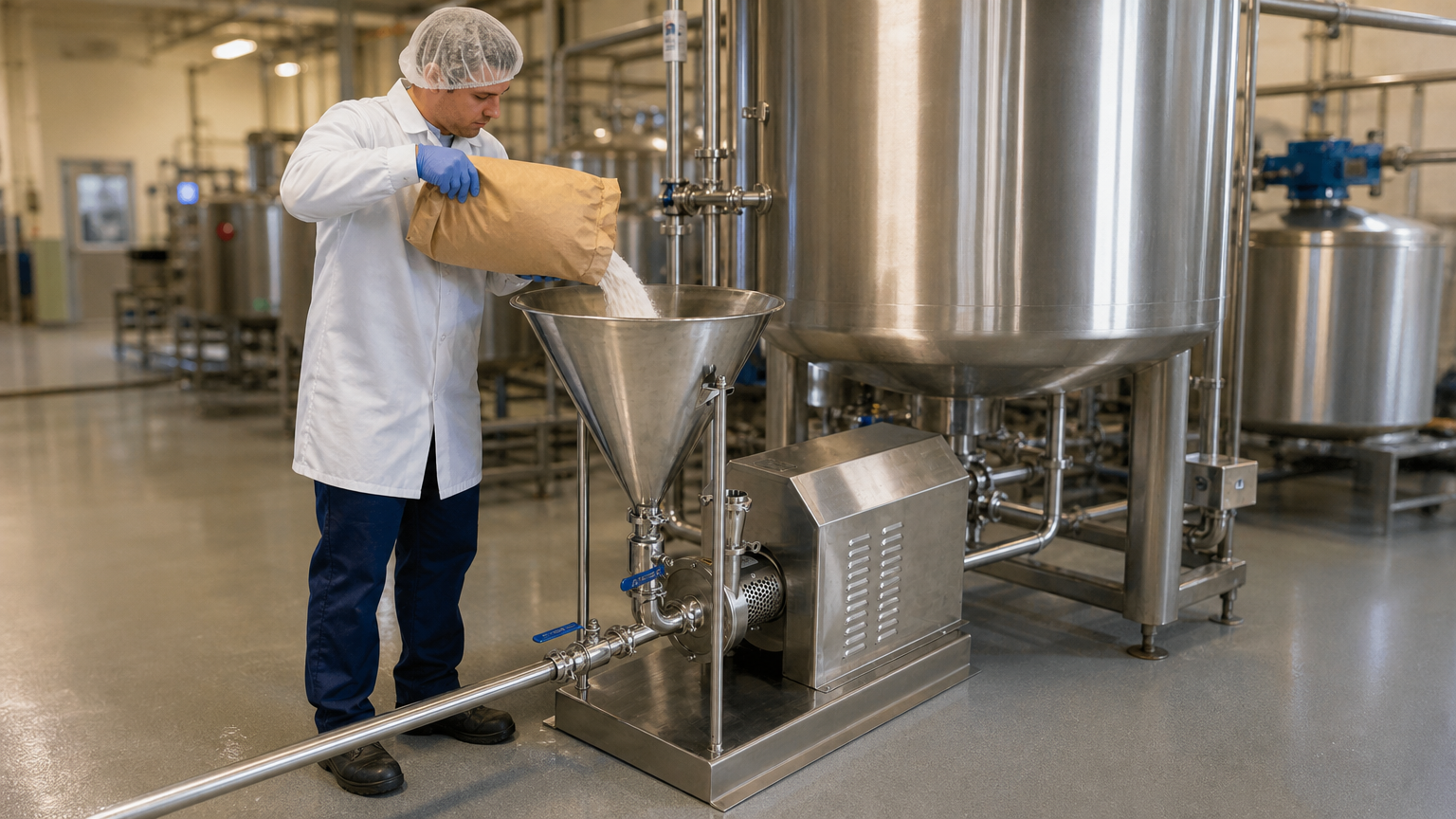
A powder induction mixer pulls the powder directly into the liquid stream at the point of highest shear, so each particle is wetted before it can clump. PerMix builds two families. The PCH shear pump has a central pumping impeller surrounded by a toothed shearing ring, giving medium shear with high flow, so it can move product to the next step without an extra pump. The PT-C series comes in four variants: PT-C/Q-LS (low shear, the most economical, also known as a tri-blender), PT-C/Q-HS (high shear), PT-C/Y (the highest vacuum, able to work with a hand wand that sucks dusty powder straight from bags or drums), and PT-C/F (two pump design). Typical products include dairy, cheese, butter, ketchup, syrups, cough syrups, ointments, creams, shampoos and gels.
Contra-rotating mixers for thicker liquids and gels
As a liquid gets thicker, a single shaft starts to spin the batch as one plug, and heat transfer at the wall suffers. A counter rotating mixer solves this with two agitators turning in opposite directions in one vessel.
On the PerMix PCR series, an outer anchor with floating PTFE scrapers turns one way while inner turbine paddles turn the other way at higher speed, each with its own drive motor. The scrapers keep product off the wall for even heating and cooling, and the inner paddles create turbulence through the bulk. It suits ointments, face creams and hair gels, can be fitted for vacuum deaeration, and lab sizes start at about 20 L working volume.
Magnetic mixers for sterile, low viscosity liquids
For vaccines, injectables and biotech media, the main risk is not mixing quality but contamination. A magnetic mixer drives the impeller through a sealed containment shell welded into the tank bottom, so there is no shaft seal to leak or harbor bacteria.
The PerMix PM series is bottom-mounted, built in SS316L, uses silicon carbide or tungsten carbide bearings, and is fully compatible with CIP and SIP cycles. It is designed for low viscosity liquids in aseptic processing.
High speed dispersers
A disperser (also called a dissolver) uses a saw-tooth disc on a high speed shaft. The disc creates a vortex that draws powder down into the liquid and shears it at the disc edge. It is the economical choice for pigments, fillers, coating formulations and other low to medium viscosity dispersions in the paint and chemical industry. The PerMix high speed disperser range runs from lab units of about 5 L up to 8,000 L, with dual and triple shaft versions for heavier products. More detail is in our dispersion mixer guide.
Mixing tanks with agitators
Not every liquid needs high shear. Many blending, dissolving and holding steps only need a well-designed tank and agitator. PerMix PA mixing tank systems range from simple portable mixers for low viscosity products to heavy-duty axial blade mixers for large batches, with dimple or open jackets for heating and cooling, vacuum or pressure designs, and ASME Section VIII Div. 1 stamping when required. Our mixing tank guide covers how to specify the vessel itself.
Inline vs in-tank mixing: which is better?
Neither is better in general. In-tank (batch) mixing is simple, flexible for many recipes, and easy to sample. Inline mixing gives every liter the same shear exposure in one pass, adds powder faster, and works well when you want to feed several tanks or run continuously.
Many plants use both. A tank with an anchor or propeller keeps the batch moving, while an inline emulsifier or shear pump runs in a recirculation loop for the high shear step or the powder addition. An inline mixer can often be added to an existing system with standard inlet and outlet connections, which makes it a practical upgrade when an older tank cannot reach the quality you need.
How do high shear and low shear liquid mixers differ?
Low shear mixers (propellers, paddles, anchors, magnetic impellers) create flow and gentle blending. They protect fragile ingredients and are fine for dissolving, holding and simple blending.
High shear mixers (rotor stator heads, inline emulsifiers, dispersers) apply intense local energy to break droplets and agglomerates. They are needed for emulsions, gum and carbomer hydration, pigment dispersion and lump-free powder addition.
The right choice often combines both: low shear for bulk turnover and high shear for the specific step that needs it.
How to choose the right liquid mixer
Selecting the right liquid mixer is easier if you answer these questions before you request a quote:
- Viscosity at the start and the end of the batch. Water-thin, honey-like, or a thick gel? The highest viscosity sets the motor torque and the type of agitator. High viscosity liquids need a mixer that can handle the load at the end of the batch, not only at the start.
- What goes into the liquid. Only miscible liquids, or powders that clump, oils that need emulsifying, or air-sensitive ingredients?
- Batch or continuous. Fixed batches in one vessel, or a line that feeds a filler?
- Temperature profile. Do you need to heat waxes, cool before adding actives, or hold a set temperature? Then you need a jacket and wall scraping for thick products.
- Air. If foam or entrapped air causes oxidation, poor appearance or filling errors, plan for vacuum mixing or a deaerator before filling.
- Hygiene and cleaning. Food, cosmetic and pharmaceutical products need stainless steel contact parts (SS304 or SS316L) for corrosion resistance, polished surfaces, sanitary valve and fitting choices, and CIP. Sterile products may need a seal-less magnetic drive.
- Quality control. Ask for sampling points and motor load or RPM monitoring, so you can check uniformity during the batch and document it.
- Hazardous area. Solvent-based products need explosion-proof (ATEX) motors, which are available on most PerMix liquid mixer series.
A short way to match the right mixer to common products:
- Thin syrups, juices and solutions: mixing tank with propeller, plus a shear pump if you add powders.
- Dressings, sauces and dairy blends: shear pump or inline emulsifier on a tank loop.
- Lotions, creams and shampoos: batch high shear mixer, or a contra-rotating or vacuum system as viscosity rises.
- Gels with carbomer or gum: powder induction mixer to avoid fish-eyes.
- Sterile injectables and biotech media: magnetic mixer.
- Paints, inks and pigment slurries: high speed disperser.
If the product becomes a heavy paste rather than viscous liquids, a liquid mixer will struggle. That is the territory of multi-shaft, planetary and sigma machines.
Our high viscosity mixer guide covers those machines and how to choose between them.
What materials are used to build an industrial liquid mixer?
Product contact parts on PerMix liquid mixers are stainless steel, usually SS304 or SS316L, with Duplex, SS 904L, titanium or Hastelloy available on several series for corrosive products. Seals are lip seals for atmospheric work or single and double mechanical seals for vacuum and pressure. Surfaces are polished, with mirror polishing or electropolishing to Ra below 0.4 micron on several series for pharmaceutical and food hygiene.
FAQ
What are liquid mixers used for?
Industrial liquid mixers blend, dissolve, suspend, disperse and emulsify liquid-based products in food and beverage, cosmetics and personal care, pharmaceutical, chemical industry and coatings plants. In short, they mix ingredients into a uniform product you can fill.
What are the two main types of mixers for liquids?
The two broad families are low shear agitators that create flow (propellers, paddles, anchors) and high shear mixers that break droplets and particles (rotor stator mixers, inline emulsifiers, dispersers).
Can a liquid mixer add powder without lumps?
Yes, if it is designed for it. A powder induction mixer or a shear pump with a hopper wets powder directly in the high shear zone, which prevents fish-eyes.
What is the difference between a liquid mixer and a homogenizer?
A homogenizer is one kind of liquid mixer. In tank and inline equipment the term usually means a rotor stator high shear head that reduces droplet size, as on the PS and PC series. Our high shear mixer working principle article explains the mechanics.
Is a kitchen hand mixer or drink frother the same as an industrial liquid mixer?
No. They share the name, but they lack controlled shear, heating, vacuum, hygienic design and the torque needed for production volumes.
Talk to PerMix about your liquid process
PerMix builds liquid mixers from lab and pilot sizes to full production lines. Send us your product, viscosity range and batch size through the contact page and we will suggest a setup that fits.