High Shear Mixer Working Principle for Dispersion and Homogenizing
· PerMix Team
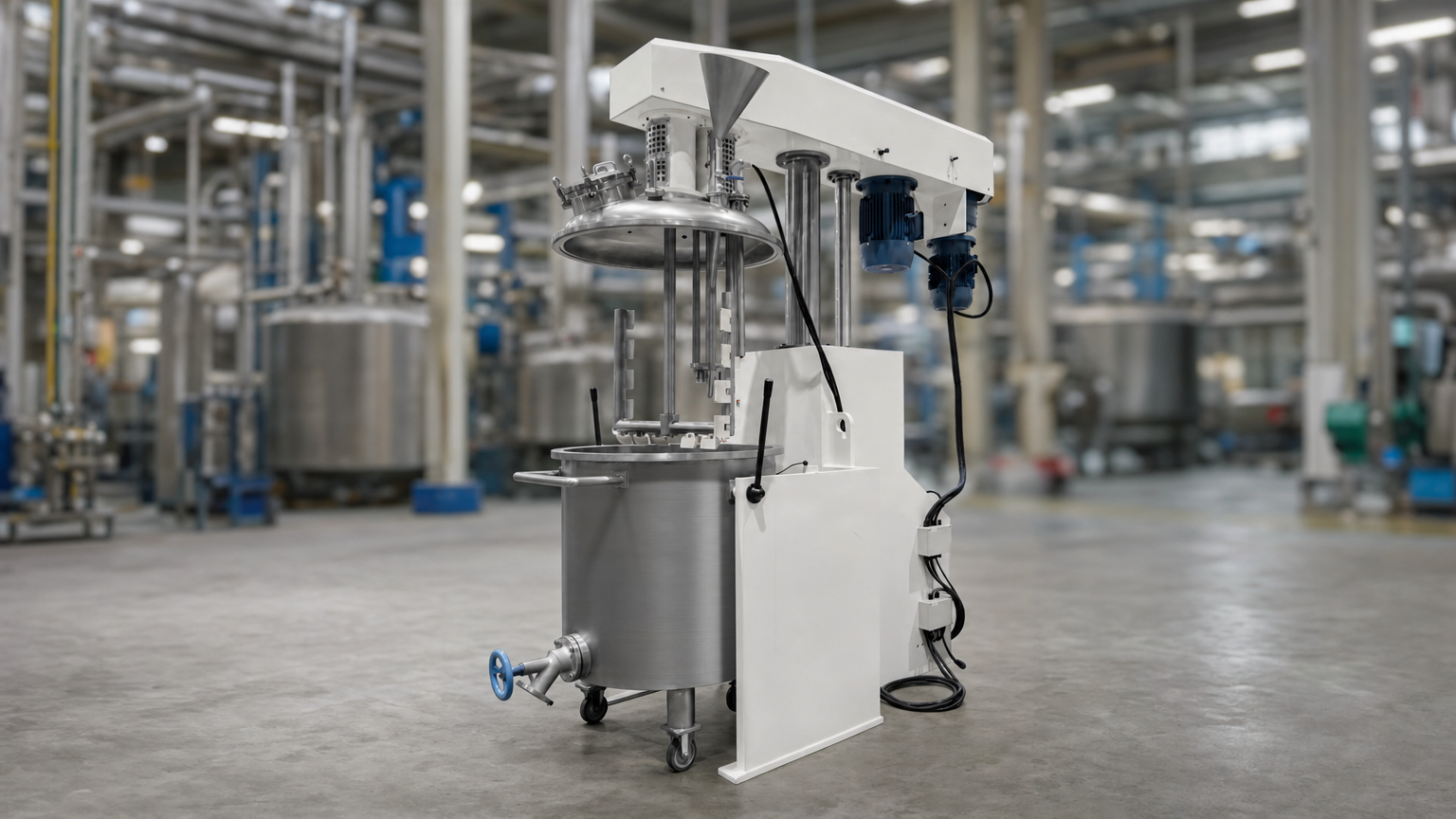
A high shear mixer is an industrial machine that uses a high-speed impeller — often a saw-tooth disperser disc — to create intense shear in a liquid or paste. Process engineers specify a high shear mixer when powders…
High Shear Mixer Working Principle for Dispersion and Homogenizing
A high shear mixer is an industrial machine that uses a high-speed impeller — often a saw-tooth disperser disc — to create intense shear in a liquid or paste. Process engineers specify a high shear mixer when powders must wet into a liquid carrier, agglomerates must break down, and a stable dispersion or emulsion is required before packaging or the next process step. This guide explains how a high shear mixer works, when a high speed disperser is the right choice, and how PerMix high speed dispersion mixers fit production lines.
Note: “high shear mixer” and “homogenizer mixer” search results sometimes point to laboratory rotor-stator kits or kitchen tools. Here we mean industrial high shear / high speed dispersion equipment for paints, coatings, chemicals, cosmetics, food pastes, and similar process duties — the same category as the PerMix High Speed Dispersion Mixer.
What is a high shear mixer?
A high shear mixer (also called a high speed disperser or dissolver) disperses solids or liquids into a liquid phase by generating a high-velocity gradient at the tip of a rotating impeller. The disc spins fast enough to create a vortex that pulls dry powder into the shear zone, where agglomerates break and particles wet out. The result is a more homogeneous dispersion than low-speed paddle or anchor agitation alone can achieve.
Industrial high shear systems may be:
- Single-shaft high speed dispersers for pourable liquids and many coating systems
- Dual-shaft (PD-2 style) combinations of a high-speed disperser with a slow-speed anchor scraper for higher viscosity turnover
- Triple-shaft (PD-3 style) layouts that add a third tool for ultra-high viscosity or multi-function processing in one vessel
Related liquid/paste tools on the PerMix line include the PerMix Emulsifier, PerMix Inline Emulsifier, and PerMix Multi-Shaft Mixer.
How does a high shear mixer work?
The working principle of a high shear mixer is tip-speed driven shear. As the saw disc impeller rotates, peripheral tip speed creates intense shear that:
- Breaks agglomerates and reduces undispersed lumps
- Wets powders rapidly into the liquid carrier via the vortex
- Promotes a uniform dispersion across the batch
In multi-shaft configurations, the high-speed head provides local turbulent shear while an anchor or screw keeps bulk material moving under more laminar flow near the walls. That combination reduces dead zones and shortens the time to a stable, repeatable dispersion — which is why many plants treat a high shear homogenizer duty as a single-vessel process rather than separate pre-mix and finish steps.
When to choose a high shear mixer vs other industrial mixers
Choose a high shear mixer / high speed disperser when:
- You must disperse powders into liquids (pigments, fillers, thickeners)
- Agglomerate breakdown and wetting dominate the cycle time
- Viscosity is still low enough for a vortex and tip-speed shear to work, or you can pair the disperser with an anchor (dual/triple shaft)
Consider other PerMix equipment when the duty shifts:
- Very high-viscosity pastes and doughs may need a PerMix Sigma Mixer or PerMix Double Planetary Mixer
- Vacuum deaeration and emulsifying under vacuum point to a PerMix Vacuum Mixer
- Dry powder blending without a liquid carrier belongs with ribbon, plow, paddle, or tumble designs — start with How to choose industrial mixers
Applications of high shear and dispersion mixers
Typical high shear mixer applications include:
- Paints, inks, and coatings pigment dispersion
- Chemical slurries and additive wetting
- Cosmetic and personal-care dispersions before emulsification
- Food pastes and syrups where powders must wet without fish-eyes
- Adhesives and sealants in the pourable-to-medium viscosity range
If your process later needs continuous powder feeding into liquids, review powder induction options on the PerMix Powder Induction Mixer page.
How to specify a high shear mixer for production
When you select a high shear mixer, document:
- Target viscosity window through the batch (start, mid, finish)
- Powder loading rate and wetting behavior
- Required shear intensity (tip speed, disc diameter, motor power)
- Whether an anchor or multi-shaft layout is needed as viscosity rises
- Vacuum, jacket heating/cooling, and discharge requirements
- Cleanability and materials of construction for your industry
Lab or pilot trials on a PerMix high speed dispersion mixer reduce scale-up risk. Configure the real machine around product, capacity, and sanitation — not a one-size catalog default. Browse the full portfolio at PerMix products or request a quote.
FAQ: high shear mixer and high speed disperser
What is the difference between a high shear mixer and a homogenizer mixer?
In industrial practice the terms overlap. A high speed disperser creates shear with a disc impeller in an open or closed vessel. A homogenizer mixer may mean a rotor-stator or high-pressure homogenizer. For many coating and paste lines, a PerMix high speed dispersion mixer covers the high shear wetting and dispersion step; confirm the exact shear tool with application engineering.
Are high shear mixers good for powders?
Yes — when powders must enter a liquid. The vortex and tip-speed shear wet and disperse solids. For dry-only blending, use powder mixers instead.
When do I need a dual-shaft or triple-shaft high shear system?
When viscosity climbs so that a single disc leaves wall zones unmixed, add an anchor scraper (dual-shaft) or a third tool (triple-shaft) so the high shear zone stays fed with fresh material.
Next step
If your line needs a high shear mixer or high speed disperser for industrial dispersion, review the PerMix High Speed Dispersion Mixer (PD/PD-2/PD-3) and contact PerMix for application support.