Vacuum Mixer Guide: When Vacuum Mixing and Emulsifying Pay Off
· PerMix Team
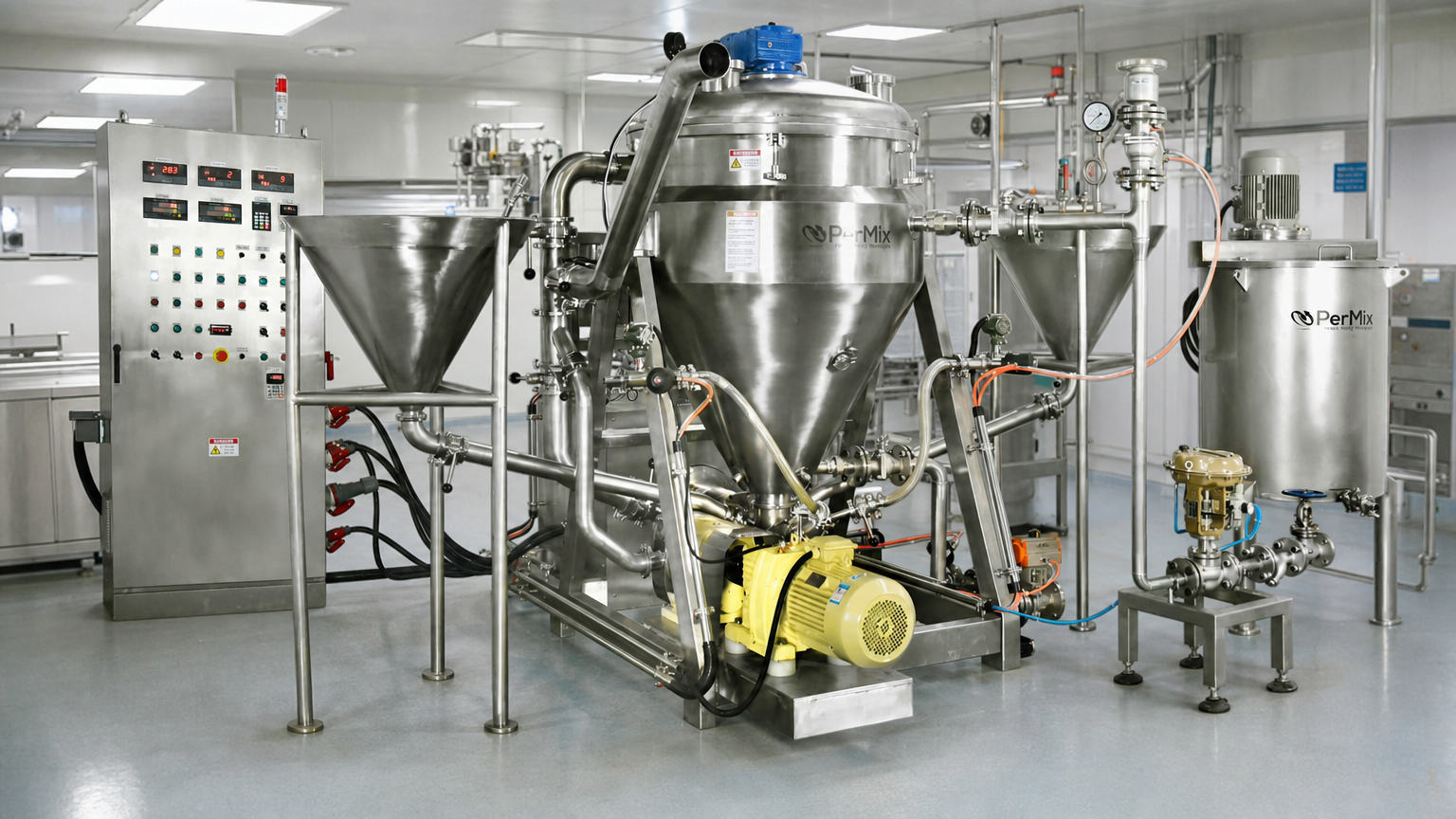
A vacuum mixer (including vacuum emulsifying mixer / vacuum homogenizer duties) pulls air out of the batch while mixing so emulsions and pastes densify, foam less, and process more consistently. This guide explains when vacuum is worth specifying versus atmospheric mixers.
A vacuum mixer applies controlled vacuum to a sealed mixing vessel so entrained air leaves the batch while agitation, emulsification, or homogenizing proceeds. Buyers also search vacuum emulsifying mixer and vacuum homogenizer for cosmetic, pharmaceutical, food, and chemical lines that need dense, stable emulsions or deaerated pastes. This is a selection guide — when vacuum mixing pays off — not a customer case study.
Product example: PerMix Vacuum Mixer.
Related when drying under vacuum is part of the same duty: PerMix Vacuum Mixer Dryer.
What vacuum mixing changes in the batch
Under atmospheric mixing, many emulsions and viscous products trap air. Bubbles raise apparent volume, weaken shelf stability, create pinholes in coatings, and distort fill weights. Pulling vacuum during or after key process steps can:
- Deaerate pastes and emulsions for denser, more consistent product
- Improve wetting of powders into liquids when air films are removed
- Support vacuum emulsifying mixer workflows with high-shear or homogenizer tools under sealed conditions
- Reduce oxidation for oxygen-sensitive ingredients when vacuum is paired with inerting practices defined by your process safety team
- Enable lower boiling-point solvent handling or drying steps when the machine is designed as a vacuum mixer-dryer
Vacuum is a process condition, not a geometry by itself. The agitator (anchor, scraper, high-shear head, homogenizer, etc.) still has to match rheology. Specify both vacuum capability and mixing tools together.
When to use a vacuum mixer
Prioritize a vacuum mixer when:
- Final product must be essentially air-free (cosmetics creams, certain gels, sealants, food purees, pharmaceutical topicals — validate to your formula)
- Homogenizing / emulsifying under vacuum is part of the validated process
- Powder incorporation creates foam that atmospheric mixing cannot collapse in time
- Downstream filling or coating fails when microbubbles remain
- You need a sealed vessel for containment plus vacuum as a controlled unit operation
Atmospheric mixers remain correct for many powder blends and simple liquid blends where air is harmless. Do not add vacuum hardware solely for brochure appeal.
Vacuum emulsifying mixer and vacuum homogenizer roles
Search terms often blur machine classes:
- Vacuum mixer: sealed vessel + vacuum system + suitable agitator for the recipe
- Vacuum emulsifying mixer: usually emphasizes emulsion formation with high-shear or rotor-stator tools under vacuum
- Vacuum homogenizer: stresses fine droplet size reduction; may be inline or in-tank depending on design
On an RFQ, describe the duty in engineering terms: target droplet size, viscosity curve, vacuum level (absolute pressure), temperature control, and CIP needs — then let applications engineering map tools. Start from PerMix Vacuum Mixer.
Vacuum mixer vs sigma kneader vs vacuum mixer-dryer
Shortlist with real PerMix URLs:
- Vacuum mixing / emulsifying: PerMix Vacuum Mixer
- Vacuum mixing with drying duty: PerMix Vacuum Mixer Dryer
- High-viscosity atmospheric or specialized kneading: PerMix Sigma Mixer
- Dry powder blending without vacuum: PerMix Ribbon Mixer
- Overall geometry choice: How to choose industrial mixers
Choose sigma when torque kneading of stiff doughs is the bottleneck and vacuum is secondary. Choose vacuum mixer-dryer when solvent or moisture removal under vacuum is a primary unit operation, not only deaeration. Choose a standard vacuum mixer when emulsifying, homogenizing, and deaeration dominate.
Selection checklist
Require vendors to address:
- Achievable vacuum level and leak-tight design (seals, sight glass, valves)
- Agitator / homogenizer configuration and tip-speed or shear range
- Jacket heating/cooling and temperature sensors
- Powder / liquid addition under vacuum (hoppers, valves, spray)
- Working volume vs total volume and recommended fill under vacuum operation
- Materials, finish, and cleanability (CIP/WIP or manual)
- Vacuum pump type, condensers, and solvent recovery if applicable
- Safety interlocks, vessel rating, and documentation for your industry
Many vacuum case studies already exist on the PerMix blog; use those for application color after the duty statement is clear. This article stays on selection logic.
Operating caveats
- Foaming can worsen if vacuum is pulled too fast on surfactant-rich formulas — ramp procedures matter
- Seal integrity and elastomer compatibility determine whether vacuum holds over a campaign
- Homogenizer energy still generates heat; jacket capacity must match
- Powder induction under vacuum needs designed addition hardware to avoid suck-back and dust issues
- Validate that vacuum improves your measured quality metrics (density, bubble count, emulsion stability), not only visual appearance
FAQ
What is a vacuum mixer used for?
Batch mixing under vacuum to deaerate and, when equipped, emulsify or homogenize products that suffer from entrained air or need sealed vacuum process steps.
What is a vacuum emulsifying mixer?
A vacuum-capable mixer configured for emulsion manufacture — typically combining vacuum with high-shear or homogenizing tools.
Is a vacuum homogenizer the same machine?
Not always. Homogenizing may be in-tank or inline. Clarify droplet-size targets and whether vacuum applies to the whole vessel or only a loop.
Vacuum mixer vs vacuum mixer-dryer?
Dryer-capable units emphasize moisture/solvent removal under vacuum with appropriate heat transfer. See PerMix Vacuum Mixer Dryer — when drying is in scope.
Where is the PerMix vacuum mixer page?
Next step
Document required vacuum level, rheology, emulsifying tools, and cleaning standards, then review PerMix Vacuum Mixer. Add the vacuum mixer-dryer page if drying is part of the same equipment decision, or the sigma mixer page if kneading torque is the real constraint.