Cosmetic Mixer Guide: Types of Cosmetic Mixing Machines and How to Choose
· PerMix Team
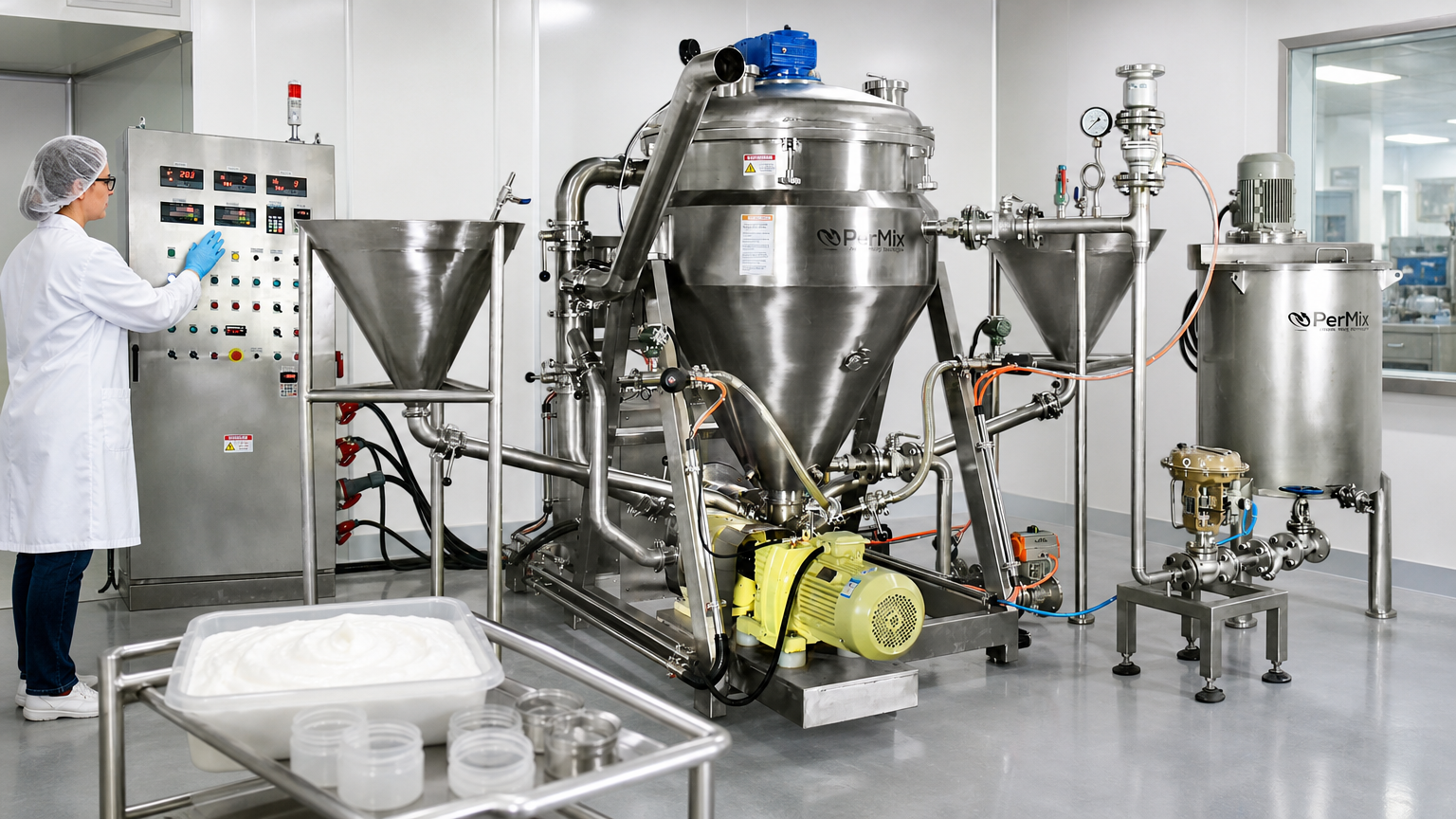
A production guide to cosmetic mixers: vacuum emulsifying mixers, high shear emulsifiers, shear pumps, multi-shaft, planetary and powder mixers for creams, lotions, shampoos, lipsticks and color cosmetics, with a selection checklist and common mistakes.
A cosmetic mixer is the machine that turns weighed raw materials for cosmetics and personal care products into a stable cream, lotion, gel, shampoo, lipstick mass or pressed powder base. There is no single "best" cosmetic mixer. A face cream, a clear hair gel and a mineral foundation fail for different reasons, so each needs a different mixing action. This guide walks through each type of mixer we see on real cosmetics manufacturing floors, what each one is good at, and how to choose without paying for features your formula does not need.
If you make cosmetic products in small batches, a mini mixer, an immersion blender or a laboratory overhead stirrer is fine for developing a new product. This guide is about the step after that: an industrial mixer for batches from a few liters to several tons, where repeatable results, air control and cleaning decide product quality and your margin in the personal care industry.
For the selection logic that applies across industries, see our guide on how to choose industrial mixers.
What does a cosmetic mixer actually have to do?
Almost all personal care products go through the same jobs, from simple stirring to high shear. The mixer has to do some or all of them in one vessel, in the right order:
- Disperse powders such as thickeners, pigments, clays and mica into a liquid or oil phase without lumps.
- Emulsify the oil phase into the water phase (or the other way around) and keep the droplet size small and even.
- Heat and cool the batch, often melting waxes at one stage and adding heat sensitive actives at the end.
- Keep air out, or pull it out, so the product does not oxidize, foam or lose gloss.
- Move thick product off the vessel wall so heat transfer stays even and there are no dead zones.
- Blend dry powders evenly for face powders, eyeshadows and clay masks.
Proper mixing in a two-phase system like a cream means the right tool for each job. The physics behind these jobs is what separates one cosmetic mixing machine from another. Shear breaks droplets and agglomerates. Bulk flow moves the whole batch through the shear zone. Scraping keeps the wall clean. Vacuum removes the air that high speed shear tends to whip in.
Types of cosmetic mixers and where each one fits
Vacuum emulsifying mixer for creams and lotions
For creams, lotions, ointments and most O/W or W/O emulsions, the workhorse is a vacuum emulsifying mixer. The vacuum emulsifying mixer from PerMix, the PVC series, combines three tools in one jacketed vessel: an anchor agitator with PTFE scrapers for the bulk, a bottom entry high shear homogenizer for droplet size, and vacuum to keep the batch air free. Phases can be heated in the jacket, emulsified, cooled and deaerated without transferring the product between separate vessels.
On the PVC, internal surfaces are polished to Ra below 0.8 micron as standard, the lid lifts electrically for access, and options include PLC and HMI recipe control, load cells under the legs for dosing, and a powder feeding hopper that uses the vessel vacuum to pull powders straight into the shear zone. That last option matters for carbomer, thickener and gum based gels, where dumping powder on the surface creates the familiar "fish eyes".
High shear emulsifier for tank based production
If you already have tanks, a high shear rotor stator head may be all you need. The PerMix PS series emulsifier comes as PS-C top entry (on the vessel flange or on a mobile stand) and PS-B bottom entry (flanged to the vessel bottom). The rotor pulls product into the workhead, throws it against the stator and forces it out through the stator openings. That cycle repeats until the whole batch has passed the shear zone enough times. It suits serums, botanical extract dispersions and skincare lotions where a separate anchor is not needed, and it can homogenize a batch at high rpm without a dedicated vessel. For a deeper look at the mechanics, see how a high shear mixer works.
Shear pump and powder induction for shampoos and gels
Shampoos, body washes and surfactant blends are high volume, low to medium viscosity products. Here an inline approach often beats a bigger tank. The PerMix PCH shear pump combines a centrifugal pump with an inline high shear head. Fitted with a hopper or feeding table, it works as a powder induction mixer that can dissolve surfactants and thickeners without lumps, a good fit for a high volume product line. PerMix reports process time reductions of up to 90% compared with conventional agitators for this kind of duty. The PCH is also designed for full CIP.
Multi-shaft and contra-rotating mixers for thick creams and gels
When a cream gets thick enough that a single anchor cannot turn the batch over, you need more than one tool. The PerMix PMS multi-shaft mixer combines slow scraping elements with a fast disperser, which is why it is used for cosmeceutical creams where concentrated actives go into a heavy base. The PCR contra-rotating mixer runs an outer anchor with floating scrapers against inner turbine paddles, giving strong turnover and better heat transfer for high viscosity gels.
Double planetary and sigma mixers for lipstick and paste
Lipstick masses, concealers and other wax rich pastes need torque, not speed. The PerMix PDP double planetary mixer moves two tools in a planetary path and is listed for viscosities up to 1,500,000 cPs. It is the usual choice for carnauba and beeswax based lipstick, where poor pigment wetting shows up as streaks. For the heaviest masses, the PSG sigma mixer kneads with two blades in twin troughs, folding and stretching the product. Our guide to the planetary mixer covers when each one makes sense.
Powder mixers for color cosmetics
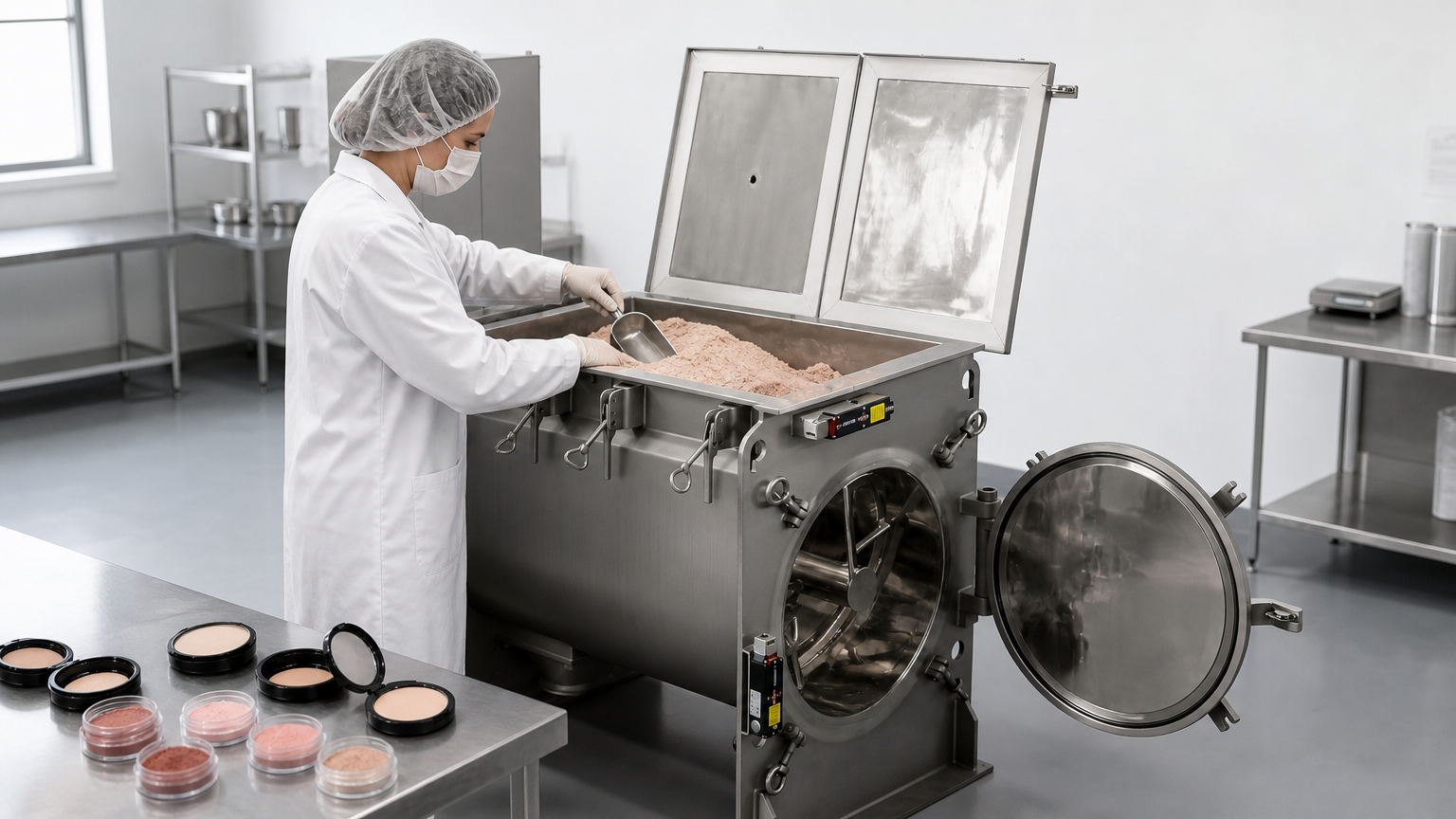
Pressed powders, foundations, eyeshadows and clay masks are dry blends, so they need powder mixers, not emulsifiers. PerMix offers three horizontal options for this:
- PRB ribbon mixer: a dual ribbon in a U trough, listed for mixing ratios of 1:500,000. Good for bulk face powders and talc bases.
- PTS plow mixer: an aggressive action listed for trace dispersion up to 1:1,000,000. Used when pigment agglomerates must be broken and color must be even.
- PTP paddle mixer: pitched paddles at lower speed, gentler on fragile mica pigments and heat sensitive clays.
When floor space is tight or the powder is micronized and fragile, vertical designs such as the PNA conical screw mixer and the PVR vertical ribbon mixer are common. For formulas with glitter, beads or encapsulated actives, the PTU 3D mixer moves product in several directions without high shear blades that would break the particles.
Vacuum deaerator for clear gels and serums
Clear hair gels and serums sold in glass or PET show every bubble. A vacuum vessel helps, but a continuous thin film deaerator after the mixer is the reliable fix. The PerMix PDA spreads product into a thin film under deep vacuum to release dissolved and entrained air, and it can be added to an existing line.
How to choose the right cosmetic mixer
Start from the product, not the machine. A good specification for cosmetic production mixing equipment answers these questions:
- What is the final viscosity, and how high does it peak during the process? A lotion that thickens on cooling needs scrapers even if it starts thin.
- Is it an emulsion, a dispersion, a dry blend, a wet paste or a job of mixing solids into liquid? That decides the main mixing action, and whether you need a stabilizer added at a specific stage.
- How sensitive is it to air? Anything with vitamins, natural oils or a clear finish should be processed under vacuum.
- Does it need heating and cooling in the same vessel? Then you need a jacket and wall scraping.
- What batch sizes do you run today and in two years? Scale up is much easier if the lab or pilot machine has the same geometry as production.
- How often do you change products and colors? Frequent changeovers make CIP, polished surfaces and easy access more valuable than extra capacity.
A quick way to map products to machines:
- Creams, lotions, ointments: vacuum emulsifying mixer, or a jacketed tank with a scraping agitator plus a high shear emulsifier.
- Shampoos, body wash, liquid soaps: tank with agitator plus inline shear pump or powder induction.
- Thick cosmeceutical creams: multi-shaft or contra-rotating mixer under vacuum.
- Lipsticks, balms, concealers: double planetary or sigma mixer.
- Pressed and loose powders: ribbon, plow or paddle mixer, or a conical or 3D mixer for fragile powders.
- Clear gels and serums: vacuum processing plus a deaerator.
If you are unsure, run your own formula on a test machine before you buy. PerMix test centers exist for exactly this.
Hygiene, materials and cleaning
Cosmetics plants work to GMP, and cleaning time often limits output more than mixing time. Points worth checking on any quote:
- Stainless steel contact parts in SS304 or SS316L as standard, with Titanium or Hastelloy available for corrosive surfactants or special actives.
- Mirror polished internal surfaces so product does not stick and wash down is fast.
- Seal above product designs (used on the PerMix PNA, PVR and PAM series) so bearings and seals never touch the product.
- Sanitary mechanical seals with no dead pockets.
- CIP spray balls or full CIP design where you change products often.
For the tank side of the line, our mixing tank guide covers jackets, finishes and agitator choice.
Common mistakes when buying a cosmetic mixing machine
These come up again and again when plants call us after the first machine did not work out:
- Buying on batch size and volume alone. A 500 L mixer that cannot scrape the wall of a thick cream will make bad product at any size.
- Skipping vacuum to save money, then fighting foam, air pockets and short shelf life.
- Using one high speed mixer for everything. High shear is great for emulsions but it can heat and damage shear sensitive actives and break mica or glitter.
- Ignoring how powders get in. Dumping carbomer on top of water is the main cause of fish eyes, and no amount of mixing time fully fixes it.
- Planning scale up later. When lab and production machines have different geometry, the texture you approved in R&D may not repeat.
FAQ
What is the best mixer for mixing cosmetics?
It depends on the product. For creams and lotions, a vacuum emulsifying mixer is the most common choice because it emulsifies, heats, cools and deaerates in one vessel. For powders it is a ribbon, plow or paddle mixer, and for lipsticks a double planetary mixer.
What is the difference between a high shear mixer and a homogenizer?
In cosmetics the terms often overlap. A rotor stator high shear mixer reduces droplet and particle size mechanically in a tank or inline. A homogenizer in a vacuum emulsifying mixer is usually the same rotor stator principle mounted in the bottom of the vessel, working together with an anchor and scrapers.
What equipment do I need to make cosmetics at production scale?
Typically a phase or premix tank, a main mixer that matches your product (emulsifier, multi-shaft, planetary or powder mixer), a way to add powders without lumps, temperature control, and often a deaerator before filling. Weighing and recipe control give precision on every ingredient proportion and help with repeatability across the production line.
Can I use a regular kitchen blender to mix cosmetics?
For small hobby batches, yes. For commercial products it does not give controlled shear, vacuum, heating or cleanable contact surfaces, so batches will vary and shelf life suffers.
How do I scale up from a lab mixer to production?
Use a lab or pilot unit with the same geometry as the production machine and scale on tip speed and heat transfer area, not just volume. The PerMix PVC series is offered from lab and pilot sizes to production sizes for this reason.
Talk to PerMix about your cosmetic line
PerMix builds a wide range of cosmetic and personal care mixing solutions for creams, gels, shampoos, lipsticks and color cosmetics, from a single economical machine to complete lines. See the full range on the cosmetics page, or request a quote with your product, viscosity and batch size and we will suggest a setup.