Paddle Mixer vs Ribbon Mixer: Which Industrial Blender Fits Your Powder Line?
· PerMix
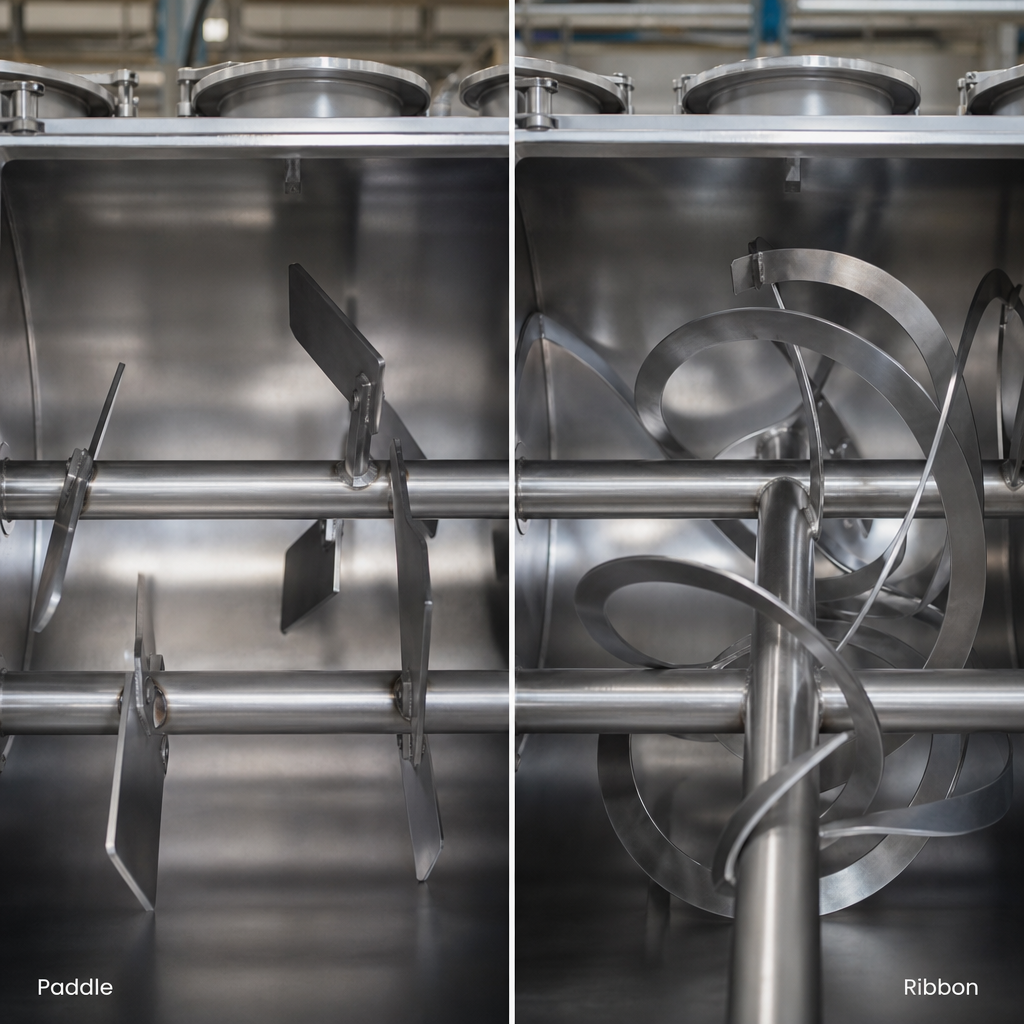
Choosing between a paddle mixer vs ribbon mixer is a common specification question on dry powder and light paste lines. Both are industrial trough mixers with an internal agitator, but the mixing action, shear level,…
Paddle Mixer vs Ribbon Mixer: Which Industrial Blender Fits Your Powder Line?
Choosing between a paddle mixer vs ribbon mixer is a common specification question on dry powder and light paste lines. Both are industrial trough mixers with an internal agitator, but the mixing action, shear level, and cleanability differ. This guide compares paddle mixer and ribbon blender duty so process engineers can pick the right machine — not a kitchen hand mixer.
What is a paddle mixer?
A paddle mixer (also called a paddle blender) uses flat or angled paddles on one or more shafts to lift, fold, and redistribute powders. It is built for gentle-to-moderate industrial mixing of free-flowing or lightly cohesive dry powders, with short cycle times and straightforward agitator inspection.
Product reference: PerMix Paddle Mixer
What is a ribbon mixer (ribbon blender)?
A ribbon mixer or ribbon blender uses inner and outer helical ribbons on a horizontal shaft. The ribbons move product in opposite axial directions so the batch is continuously folded along the trough. Ribbon blenders are workhorses for many general powder blending jobs and some light paste additions.
Product reference: PerMix Ribbon Mixer
Paddle mixer vs ribbon mixer: key differences
- Agitator geometry: paddles vs double helical ribbons
- Shear profile: paddle mixing is often gentler; ribbon action can be more aggressive folding along the trough
- Typical duty: paddle for free-flowing powders needing turnover; ribbon for broad powder blending and many standard batch recipes
- Cleanability: paddle blades are often easier to inspect visually; ribbon flights have more surface area to wash
- Fill and cycle time: both depend on fill ratio, bulk density, and recipe — validate with trials
When a paddle mixer is the better choice
- Gentle blending of free-flowing dry powders
- Recipes that need moderate turnover without high shear
- Lines that value easy paddle and seal inspection
- Duties adjacent to plow or high-shear equipment when you only need convective mixing
See also: Paddle mixer working principle
When a ribbon blender is the better choice
- General-purpose powder blending across many SKUs
- Batches that benefit from continuous axial folding
- Plants already standardized on ribbon mixer spares and SOPs
- Duties described in ribbon blender uses and applications guides
See also: Ribbon mixer working principle
How to decide: paddle blender vs ribbon blender
Document the process duty before comparing quotes:
- Target uniformity (for example CV) and mixing time
- Bulk density and particle size range of major ingredients
- Liquid addition yes/no
- Cleanability and cross-contamination limits
- Batch size and available footprint
If you are still mapping families of industrial mixers, start here: How to choose industrial mixers
Related PerMix powder equipment
FAQ: paddle mixer vs ribbon mixer
Which is better, paddle mixer or ribbon mixer? Neither is universally better. Match shear, geometry, and cleanability to the recipe and validate with a trial.
Is a ribbon blender the same as a ribbon mixer? In industrial powder equipment, ribbon blender and ribbon mixer usually mean the same helical-ribbon trough blender.
Can a paddle mixer replace a ribbon blender? Sometimes for free-flowing powders. Sticky, segregating, or liquid-heavy duties may still prefer ribbon, plow, or another geometry.
What about handheld paddle mixers for mortar? Those are construction tools. This article is about stationary industrial paddle mixers and ribbon blenders for process plants.
Next step
If your line needs a clear paddle mixer vs ribbon mixer decision, review the PerMix paddle and ribbon product pages, then request application support with your duty statement. Contact