Lump Breaker Guide: How an Industrial Delumper Protects Your Powder Line
· PerMix
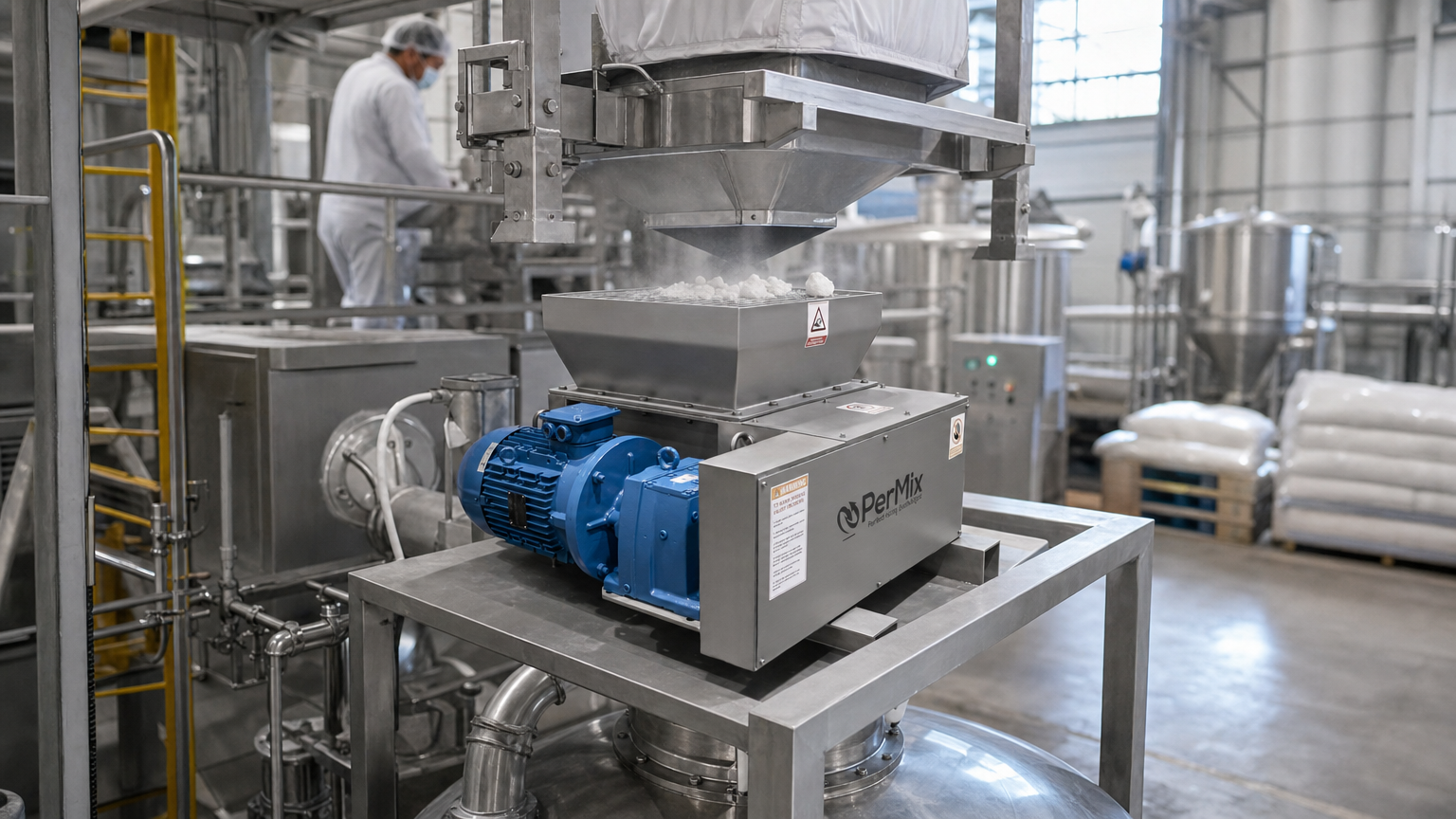
What a lump breaker does, how it works, where to install it and how to size a PerMix PLB delumper for caked or compacted powders.
A lump breaker is a size reduction machine that breaks caked, compacted or agglomerated powder back into a free-flowing state before it reaches a mixer, conveyor or packing line. It does not grind material into a finer powder. It restores the particle size the material had before it absorbed moisture or sat under load in a silo or bulk bag.
For plants that blend powders, a lump breaker is often the cheapest insurance against failed homogeneity tests, blocked hoppers and damaged feeders. This guide explains how an industrial lump breaker machine works, where it sits in a material handling line, how to size it, and what to specify when you request a quote.
What is a lump breaker?
A lump breaker, also called a delumper or lump crusher, is a rotor and comb machine built to break lumps and agglomerates in bulk material. Material enters from above, rotating blades shatter the lumps against fixed combs or a grate in the crushing chamber, and the product leaves through the bottom at the desired size. In short, it turns large lumps into smaller pieces that are manageable and flow.
The PerMix PLB series lump breaker is part of the PerMix specialty equipment range. It is used in pharmaceutical, nutraceutical, food processing, chemical industry, bio and health and beauty plants, where product quality and process reliability matter more than anything else.
Lump breaker vs mill: what is the difference?
A mill is built to grind and reduce the size of the primary particles into finer particles. A lump breaker only breaks the bonds between particles that have stuck together. The blade geometry is designed to fracture lumps without producing excessive fines or changing the primary particle size, so a lump breaker protects the physical characteristics your recipe was formulated around.
It is also different from heavy crushers and shredders used for cement clinker, coal or plastic recycling. That machinery is built to shred hard materials. A powder lump breaker is built for friable cakes and clumps in powders and granules.
How does a lump breaker machine work?
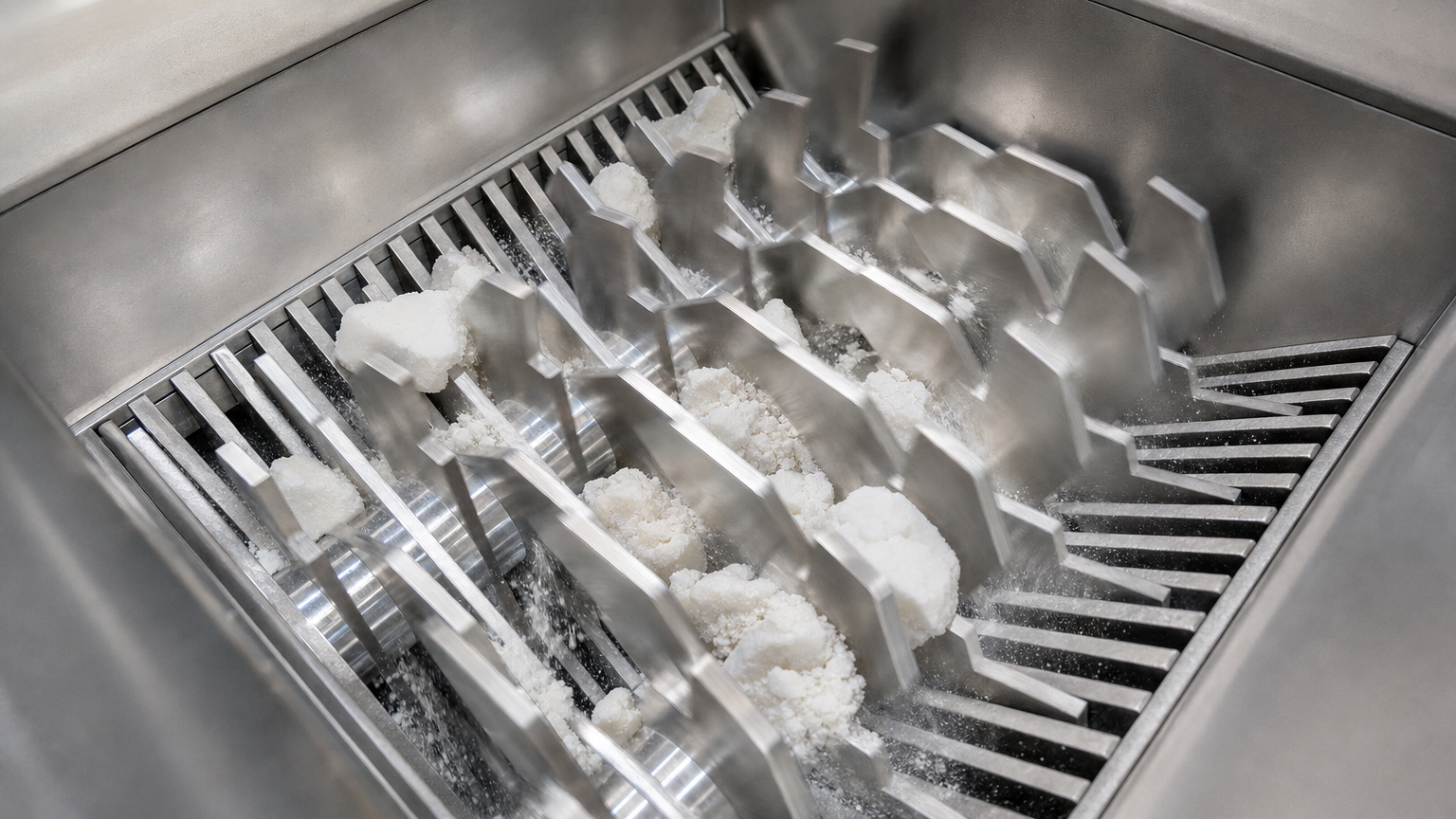
The working principle of lump breaking is mechanical impact and shear at high peripheral speed:
- Lumpy material is fed by gravity from a bag dump station, big bag discharger, silo outlet or conveyor.
- Knives or blades rotate on a central shaft and strike the lumps.
- The rotating elements pass between stationary combs or a fixed grate, which holds the lumps in the cutting zone until they break.
- Broken material falls through to the outlet at a size set by the clearances and the sizing screen.
- Downstream equipment receives a consistent, flowable feed.
Because the housing is precision machined to hold exact clearances, every particle is reduced to the specified size before it leaves the unit.
Why lumps form in powders
Most lumps are created after the powder was made, during storage and transport:
- Hygroscopic powders absorb moisture when humidity is high and form clumps. The higher the moisture content, the harder the cake.
- Material stored in silos or bulk bags compacts under the weight of the column above it, a process called compaction caking.
- Temperature swings during shipping cause moisture migration and crusting.
- Long storage times turn soft agglomerates into hard cakes.
These masses are too dense for a standard blender to break down on its own, and they rarely disperse during a normal mixing cycle. Their hardness decides how much energy the lump breaking machine needs, and it is the first thing to tell your supplier.
When do you need a lump breaker?
You need a lump breaker when lumps reach equipment that cannot tolerate them. Typical triggers:
- Breaking hygroscopic, caked or compacted powders before mixing.
- Eliminating bridging and rat holing in hoppers, silos and bag dump stations.
- Protecting downstream mixers, pumps, sifters and rotary valves from hard lumps.
- Restoring a consistent particle size after long storage or transport.
- Guaranteeing batch homogeneity in pharma and nutraceutical recipes.
- Recovering off spec material and reintroducing it into production.
Protecting the mixer and the batch
A lump that enters a ribbon mixer or a conical screw mixer can stay sequestered in a dead zone for the whole cycle. The result is a failed homogeneity test or an unmixed lump in the final package. Installing a lump breaker as a pre-processing step ahead of these high precision mixers removes that risk at the source.
Protecting downstream equipment
Hardened agglomerates can damage high speed pumps, score conveyor surfaces, block screw conveyors and jam fine tolerance rotary feeders. Breaking lumps at the start of the process minimizes downtime, reduces unplanned maintenance and keeps the whole workflow running for efficient processing and higher productivity.
Where to install a lump breaker in your line
The right position depends on where lumps enter your process:
- Under a bag dump station or big bag discharger, where caked raw material is first opened.
- Directly on the inlet of a mixer. PerMix can mount a PLB on the inlet of a PRB ribbon mixer so de-agglomeration happens as the batch is charged.
- Inside a pneumatic conveying line, so lumps are broken during material transfer.
- After a dryer or cooler, where product can crust before packing.
If you are planning a new process, consider the lump breaker as part of full line solutions rather than a separate purchase. Inlet and outlet flanges, dust tight connections and controls are easier to get right when the whole line is engineered together.
Lump breaker design and construction
Types of lump breakers: single-shaft and double-shaft
The PLB can be configured with a single-shaft or a double-shaft rotor. The choice depends on the required throughput and how tough the lumps are. As a rule of thumb, double-shaft designs are chosen for harder cakes and higher capacities, while single-shaft designs suit softer agglomerates and compact installations. This versatility lets one machine family cover very different material processing duties.
Drive system
- Gear motor drives for high torque, steady state crushing.
- Chain transmission drives where shock absorption is needed when large cakes first hit the blades.
Materials of construction
Contact parts can be fabricated from carbon steel, SS304, SS316 or SS316L, titanium, duplex stainless steel or Hastelloy. Titanium and Hastelloy are recommended for highly corrosive, acidic or chloride rich materials. Duplex stainless steel gives higher yield strength for high stress applications. For abrasive products, the breaking elements can be supplied with tungsten carbide coatings or equivalent hardened surfaces.
Options and customization
PerMix follows a customized solutions approach, so each PLB is configured around the material and the line:
- Interchangeable sizing screens. A grate above the cutting blades stops oversized lumps from blocking the working zone and lets you switch between coarse breaking and finer de-agglomeration.
- ATEX rated explosion proof components for combustible dusts in hazardous zones, with motors and grounding to international safety standards.
- VFD speed control. Changing the rotor speed adjusts both output capacity and final product size to your target.
- Sanitary finishes, custom inlet and discharge arrangements, safety guarding and integration with upstream and downstream equipment.
Lump breaker sizes and capacity
The representative PLB range is listed below. Throughput and motor power depend on the product, and customized capacities are available on request. PerMix rates capacity in m3/h; if your plant works in tons per hour, convert using the bulk density of your material.
- PLB-1: crushing area 300 x 300 mm, throughput 15 to 35 m3/h, motor 2.2 kW, approx. 685 x 660 x 260 mm.
- PLB-2: crushing area 450 x 450 mm, throughput 25 to 45 m3/h, motor 5.5 kW, approx. 880 x 845 x 350 mm.
- PLB-3: crushing area 550 x 550 mm, throughput 30 to 50 m3/h, motor 7.5 kW, approx. 1,000 x 1,000 x 425 mm.
To pick a size, start from your peak feed rate in m3/h, the largest lump you expect at the inlet and the outlet size your downstream equipment needs. Then match the crushing area to the inlet you are connecting to.
Selecting the right lump breaker: checklist
Bring these details to your supplier and you will get a faster, more accurate recommendation:
- Material name, bulk density and whether it is hygroscopic, sticky, abrasive or heat sensitive.
- Largest lump size at the inlet and required maximum size at the outlet.
- Required throughput in m3/h or kg/h, plus batch or continuous operation.
- Upstream equipment (bag dump, big bag discharger, silo, dryer) and downstream equipment (mixer, conveyor, sifter, packer).
- Hygiene and cleaning requirements, including food or GMP pharmaceutical duty.
- Hazardous area classification and dust explosion risk.
- Preferred materials of construction and available footprint.
Good data lets the engineer optimize the design for your material size, feed rate and subsequent processing. If you are still deciding which mixer sits after the lump breaker, our guide to industrial mixers explains how to match mixer type to product and process.
How do you maintain a lump breaker?
A lump breaker has few moving parts, so maintenance is mostly about wear and clearances:
- Inspect blades, combs and the sizing screen for wear, especially with abrasive products.
- Check rotor to comb clearances, because worn clearances let oversized lumps pass.
- Follow the cleaning regime for your product, more often for sticky or hygienic duties.
- Specify hardened or tungsten carbide breaking elements for abrasive materials to extend longevity.
For lines where a stuck lump stops production, a lump breaker is an indispensable part of production efficiency, not an accessory.
FAQ: lump breakers
What does a lump breaker do?
A lump breaker breaks caked, compacted or agglomerated powders and granules into a uniform, flowable material. It restores the original particle size so the product feeds, mixes and conveys reliably, from chemicals to foodstuff.
Is a delumper the same as a lump breaker?
Yes. Delumper, de-lumper, lump crusher and lump breaker describe the same class of machine: a rotor that breaks agglomerates against combs or a grate.
Will a lump breaker create fines?
A well designed lump breaker breaks the bonds between particles without grinding the particles themselves. Blade geometry, rotor speed and screen size are chosen to limit fines.
Where should a lump breaker be installed?
Install it where lumps first appear: under bag dump stations and big bag dischargers, on silo outlets, on a mixer inlet or inside a pneumatic conveying line.
Can a lump breaker handle hazardous or corrosive materials?
Yes, when it is specified for the duty. PerMix offers ATEX rated components for combustible dusts and contact parts in titanium, duplex stainless steel or Hastelloy for corrosive products.
How do I size a lump breaker?
Size it from peak throughput, maximum inlet lump size, required outlet size and the inlet flange you are connecting to. The PLB range covers 15 to 50 m3/h in standard models, with custom sizes on request.
Talk to a PerMix engineer
PerMix has been designing and manufacturing mixing and processing equipment since 1954, with bench, pilot and production scale machines available for trials at PerMix labs or shipped to your site. Send us your material, lump size and throughput, and we will recommend the right PLB configuration for your line.