Industrial Mixing Equipment Guide: What Goes Into a Complete Mixing Line
· PerMix Team
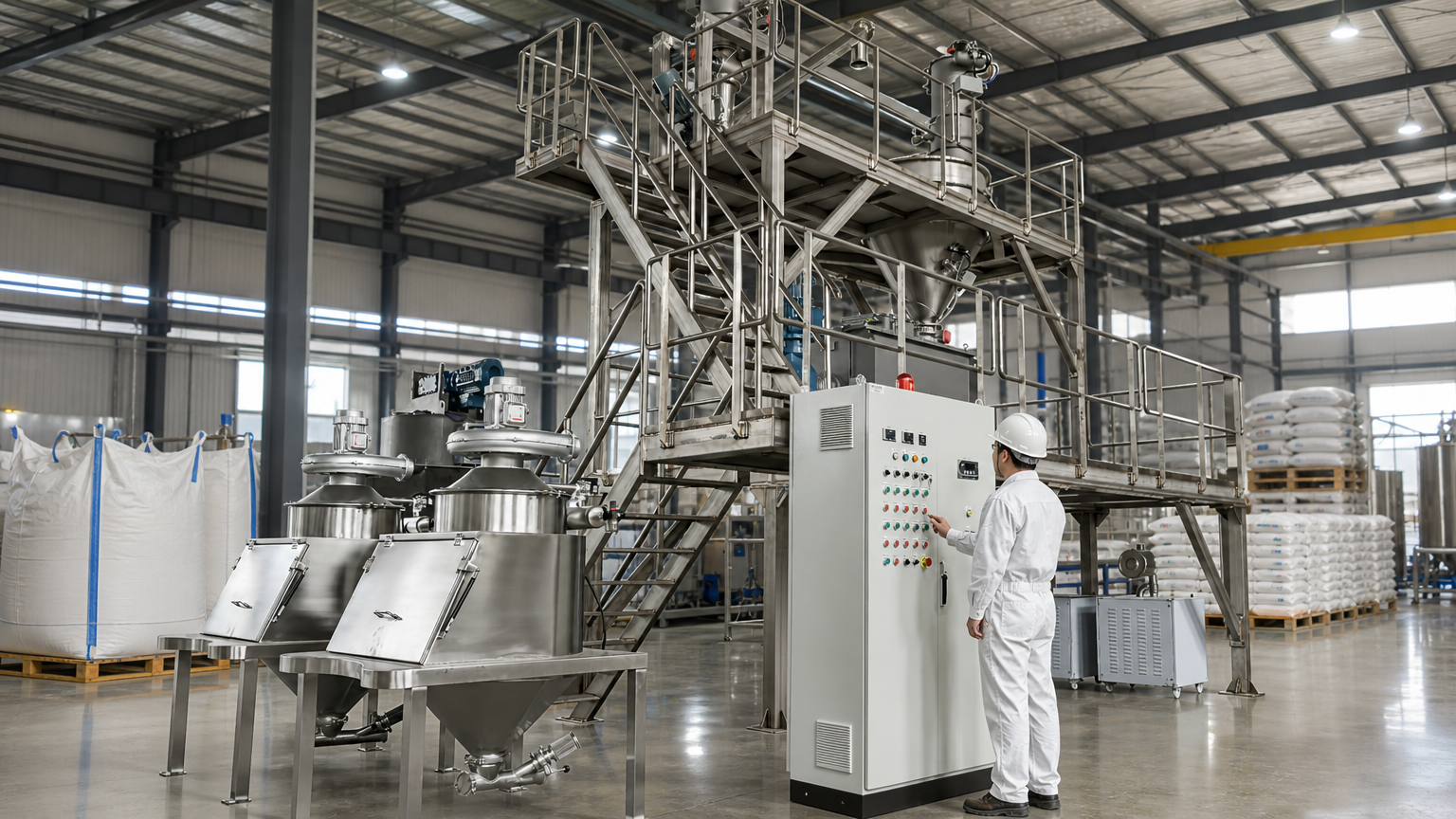
A plant floor guide to industrial mixing equipment: intake and conveying, lump breakers, dosing and liquid addition, the core mixer, drying, sterilizing and deaeration, discharge, CIP and controls, plus a specification checklist and common buying mistakes.
Industrial mixing equipment is more than the mixer. In a working plant the mixer sits in the middle of a chain: raw materials come in, get weighed, delumped and conveyed, liquids are sprayed or dosed, the batch is mixed, maybe heated, dried, sterilized or deaerated, and then it is discharged and packed. When a line underperforms, the cause is very often one of the machines around the mixer, not the mixer itself.
This guide explains each part of a modern mixing line, what it does, and how to decide what you actually need. If you only need help picking the right industrial mixer, start with our guide on how to choose industrial mixers and come back here for the rest of the system. Mixers are used in almost every process industry, but the equipment around them is where most lines win or lose.
What counts as industrial mixing equipment?
Industrial mixing equipment covers every machine that touches the product from intake to packaging and affects how well it mixes. Mixing equipment is used in food processing, pharmaceutical, cosmetics, chemical manufacturing and battery plants, and in practice we group it into six stages:
- Raw material intake and handling: drum dumpers, bag tipping stations, big bag unloaders and conveyors.
- Conditioning: lump breakers, sieves and preheating.
- Dosing and liquid addition: weighing systems and spray nozzles.
- Mixing: the core mixing machine for powders, pastes or liquids.
- Process steps around the mix: heating and cooling, vacuum drying, sterilizing, deaeration.
- Discharge, filling and cleaning: discharge valves, bag filling, CIP and the control system that ties it all together.
A small plant may only need two or three of these. A high volume food and pharmaceutical line, or a battery materials line in the chemical industry, may need all of them in one integrated system. The mixing requirements of the product decide which stages you need, not the catalog.
Stage 1: raw material intake and bulk handling
Most mixing problems that look like "poor homogeneity" in the mixing process start here. Operators lift heavy sacks, dust escapes, and minor ingredients are added in the wrong order. Good intake equipment fixes three things at once: safety, dust and repeatability.
- Drum dumpers lift and empty drums into a hopper in a sealed way. PerMix drum dumpers are built for exactly this.
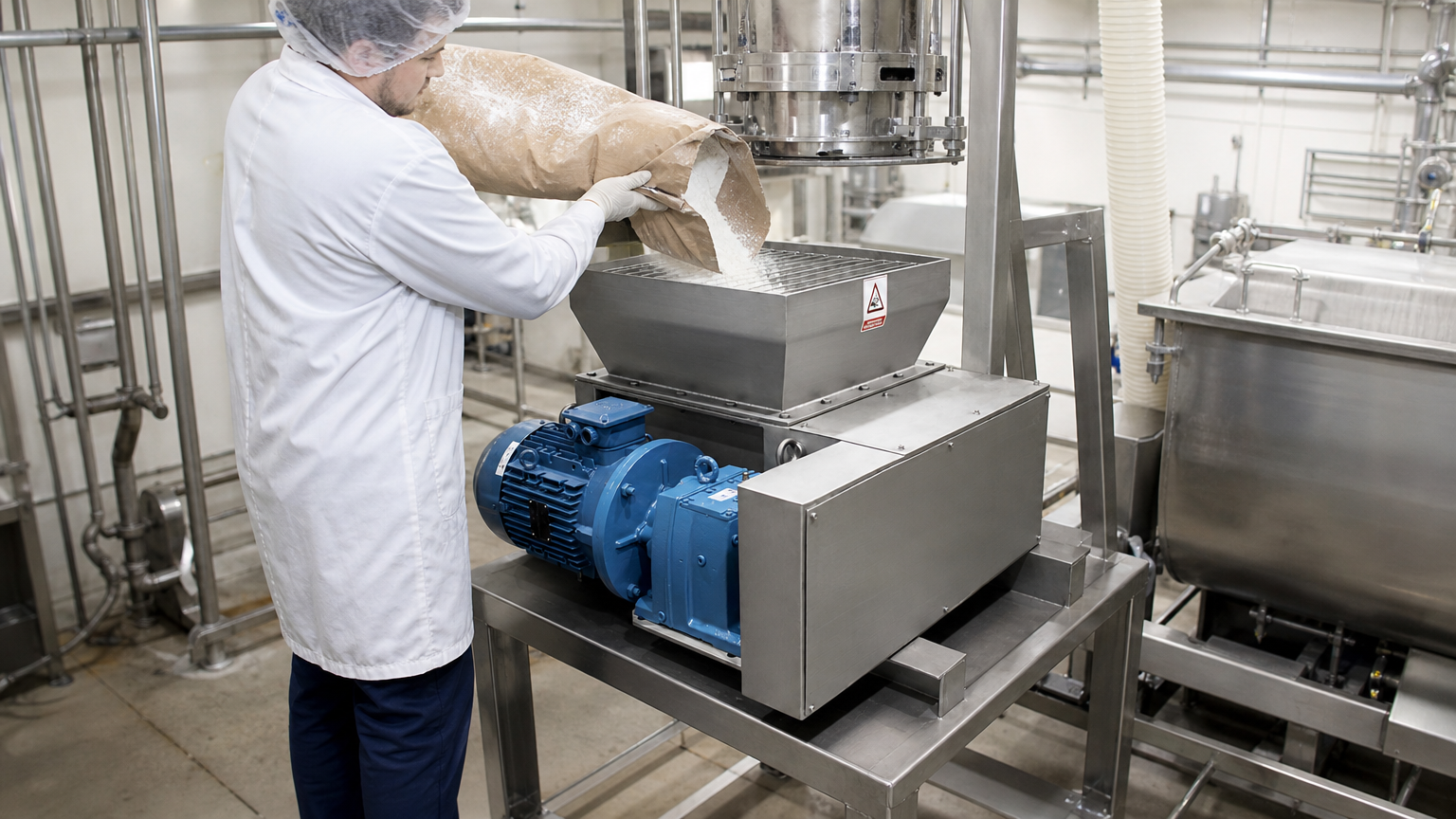
- Bag tipping stations with lids let operators empty sacks at a safe height with local dust extraction.
- Vacuum and pneumatic conveying moves powder from intake to the mixer in a closed pipe, so the mixer can sit on a platform and the operator stays on the ground. See our notes on vacuum conveying.
Rule of thumb from the field: if operators climb a ladder with sacks to load a mixer, the line needs intake equipment before it needs a bigger mixer.
Stage 2: conditioning powders before they reach the mixer
Hygroscopic and stored powders arrive caked. Sugar, salt, milk powder, many chemicals and pharma excipients form lumps that no mixer fully breaks in a normal cycle time. A lump breaker placed after the intake point fixes this. The PerMix PLB uses rotating profiled blades that intermesh with a stationary comb or grate, so lumps are broken without grinding the primary particles into fines.
Stage 3: dosing, weighing and liquid addition
Mixing quality can never be better than dosing accuracy. Load cells under the mixer or the hopper give you a real batch weight instead of a sack count. For liquids, the way you add them matters as much as how much you add. Pouring oil or binder onto a powder bed creates wet balls. Fine atomizing nozzles spread the liquid over a large surface while the mixer turns the bed, which is why liquid adding nozzles are standard on PerMix full lines. Our article on fine spray explains why this matters for difficult liquids.
Stage 4: the industrial mixer at the core of the line
The industrial mixer is still the heart of the system, and choosing the right mixer comes down to the material, the mixing intensity it can take and your process requirements. The common mixer types used in industrial environments:
- Dry powders and granules: a ribbon blender for general powder mixing, paddle mixers for gentle and fast uniform mixing of fragile or mixed density solids, plow mixers for high intensity and liquid addition, a conical screw mixer for gentle vertical blending, and tumble blenders such as V blenders and drum mixers. Our powder mixer guide compares them.
- Pastes and high viscosity products: sigma mixers, planetary mixers and multi-shaft mixers for adhesive, sealant, dough and cream type products.
- Mixing liquids, emulsions and slurry: mixing tanks with an agitator (industrial agitators range from anchors to turbines), high shear emulsifiers, dispersers and inline mixers.
- High volume, single recipe products: continuous mixers instead of batch mixers.
Batch mixing or continuous mixing is a line decision, not a mixer decision. A continuous mixer only works if the feeders upstream are continuous and accurate too. Lab scale trials matter here as well: laboratory mixers with the same geometry as the production industrial mixer let you confirm mixing performance before you commit to a full scale line.
Stage 5: heating, cooling, drying, sterilizing and deaeration
Many products need more than a mix. Building these steps into the same equipment saves transfers, floor space and product loss:
- Heating and cooling: jacketed mixers and mixing tanks for melting, cooking or cooling a batch.
- Vacuum drying: a vacuum mixer dryer mixes and dries in one vessel at lower temperature, with vacuum and condensing equipment to recover solvent or water.
- Steam sterilization of powders: the PerMix PAMD-SS steam sterilizer is a vertical batch mixer with steam injection for spices, food powders and similar products.
- Deaeration of liquids and pastes: the PerMix PDA deaerator removes air in a continuous thin film under vacuum, with capacities listed up to 30,000 L per hour.
- Heated transfer: thermal auger conveyors heat or dry product while moving it between steps.
Stage 6: discharge, filling, cleaning and controls
The last stage decides how much product you sell and how long changeovers take.
- Discharge valves sized and placed so the mixer empties fully. A mixer that holds back 2% of every batch is losing money every shift.
- Integrated bag filling under the mixer cuts handling and dust. PerMix offers sanitary ribbon mixers with bag filling for this.
- CIP units reduce manual cleaning in food and pharma lines.
- Controls range from a simple push button panel to full PLC and HMI automation with recipe control, SCADA integration, data logging and Ethernet/IP communication.
Standalone machines or a full line?
Not every plant needs a turnkey line. A simple way to decide:
- Buy standalone machines if you are replacing one bottleneck, your upstream and downstream steps already work, and your team can integrate the controls.
- Go for a full line if you are building a new plant or room, if dust, operator safety or GMP documentation are problems today, or if several suppliers would have to talk to each other to make the line work.
PerMix full line solutions are built around PerMix mixers as the core unit, with bulk handling, heating and cooling, vacuum and condensing equipment, liquid adding nozzles, CIP and controls engineered as one system for food, pharma, chemical, battery and waste treatment plants. If you need a machine fast, check the in-stock machines first.
How to specify industrial mixing equipment: a checklist
Before you ask anyone for a quote, write these down. It saves weeks of back and forth:
- Product description, bulk density, particle size, moisture, viscosity and flow behavior for every main ingredient, solid or liquid.
- Minor ingredients and their ratio, especially anything below 1% of the batch.
- Batch size or hourly output, today and in three years.
- Process steps beyond mixing: liquid addition, heating, cooling, drying, vacuum, sterilizing.
- Hygiene level (industrial, sanitary food, pharmaceutical) and materials used for contact parts, usually stainless steel 304 or 316L.
- Hazardous area classification, if solvents or combustible dust are present.
- How the product arrives (sacks, drums, big bags, silo) and how it leaves (bags, drums, IBC, next process).
- Cleaning frequency and how many products share the line.
- Available floor space and ceiling height.
- Utilities: power, steam, cooling water, compressed air, vacuum.
Common mistakes when buying mixing equipment
- Sizing the mixer on volume and forgetting bulk density. A 1,000 L mixer full of a light powder and full of a dense mineral are very different loads.
- Buying the mixer first and the intake equipment later, then finding there is no headroom for a hopper or conveyor.
- Adding liquids by hand from a bucket and blaming the mixer for lumps.
- Ignoring discharge. Slow or incomplete emptying often costs more than a slower mixing cycle.
- Skipping a trial. Testing your own product on a real machine is the cheapest insurance you can buy. PerMix test centers are set up for this.
FAQ
What is industrial mixing equipment?
It is the set of machines used to blend raw materials into a uniform product at production scale, including the mixer itself and the equipment around it for intake, conveying, delumping, dosing, heating, drying, deaeration, discharge, cleaning and control.
What are the main types of industrial mixing machines?
Industrial mixers and blenders fall into four groups: powder mixers (ribbon blender, paddle, plow, conical screw mixer, tumble and drum), paste mixers for viscous products (sigma, double planetary, multi-shaft), liquid mixers (agitated tanks, high shear emulsifiers, dispersers, inline mixers) and continuous mixers. Common applications range from food and pharmaceutical powders to adhesive pastes and chemical slurry.
What is the difference between a mixer and a mixing system?
A mixer is one machine. A mixing system adds the feeding, weighing, conditioning, process and discharge equipment and the controls, so the whole line runs as one unit.
Do I need a full mixing line or just a new mixer?
If only the mixing step is the bottleneck, a new mixer is enough. If problems come from loading, dust, lumps, liquid addition, discharge or cleaning, the fix is in the equipment around the mixer.
How long does it take to build an industrial mixing line?
It depends on scope and certification. A standalone machine from stock is the fastest route. A custom full line takes longer because it is engineered, built and tested as one system, so share your process details early.
Plan your mixing line with PerMix
Send us your product, output and process steps and a PerMix engineer will suggest the mixing solutions that fit, from a single mixer to a complete line. Request a quote to get started.