Paddle Mixer Working Principle for Industrial Powder Blending
· PerMix Team
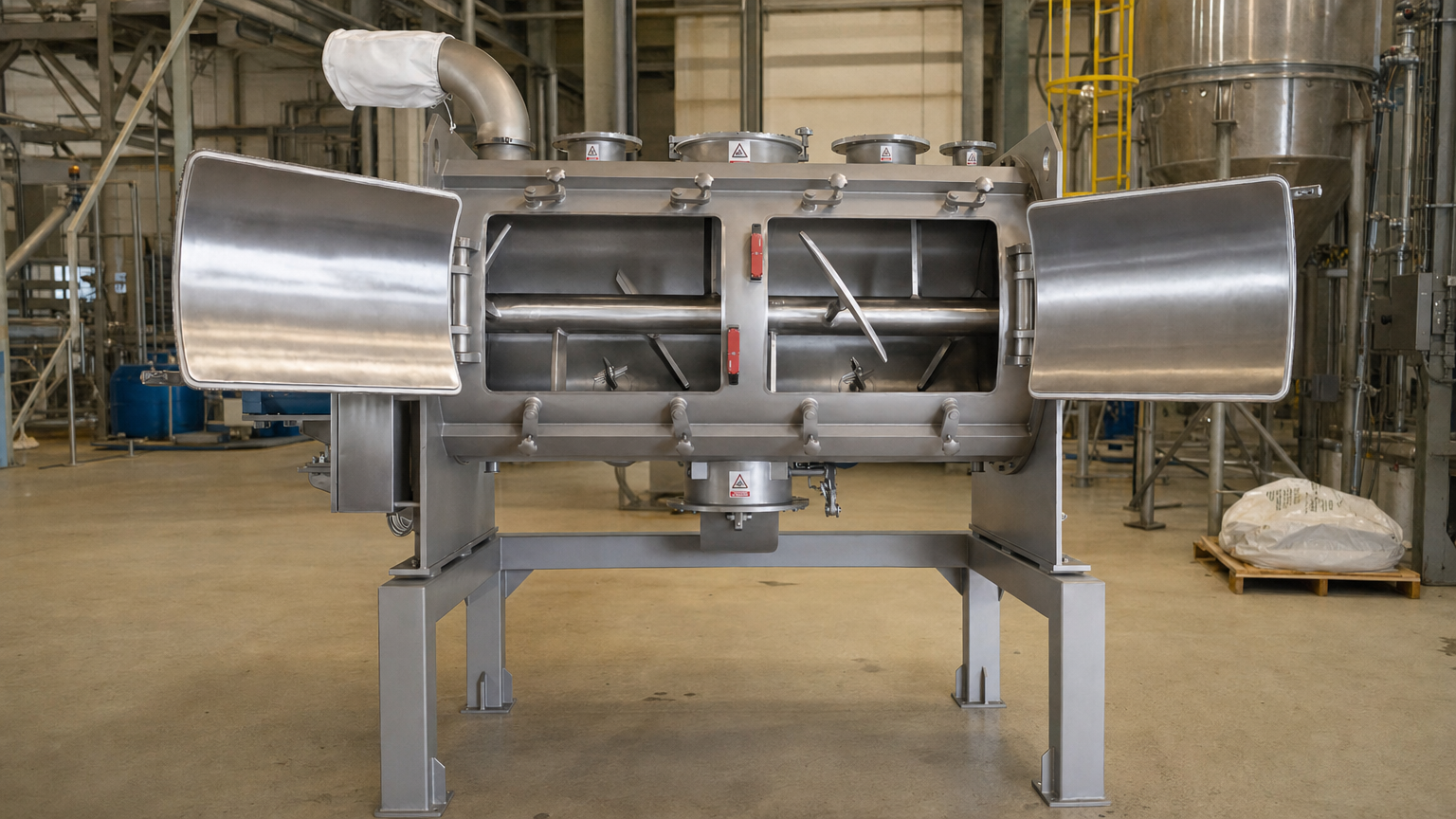
A paddle mixer is an industrial powder blender that uses rotating paddles inside a trough or drum to lift, fold, and redistribute solids. Process engineers choose a paddle mixer when the line needs gentle-to-moderate…
Paddle Mixer Working Principle for Industrial Powder Blending
A paddle mixer is an industrial powder blender that uses rotating paddles inside a trough or drum to lift, fold, and redistribute solids. Process engineers choose a paddle mixer when the line needs gentle-to-moderate mixing, short cycle times, and easy discharge for free-flowing or lightly cohesive powders. This guide explains how an industrial paddle mixer works, where it fits versus ribbon or plow designs, and how to specify one for production.
Note: search results for “paddle mixer” often show handheld drill paddles for mortar or paint. Those are construction tools. Here we mean a stationary industrial paddle mixer for powder blending on a process line — the same category as the PerMix Paddle Mixer.
What is an industrial paddle mixer?
An industrial paddle mixer is a mixing machine with one or more horizontal shafts fitted with paddle blades. As the shaft turns, each paddle moves material through a defined path so layers of powder are continuously exchanged. The goal is uniform mixing without the high shear of a plow mixer or the aggressive kneading of a sigma mixer.
Typical builds include a U-shaped or cylindrical trough, sealed shaft ends, a drive motor with gear reducer, and a bottom or end discharge. Lab and pilot paddle mixer sizes support recipe development; production units scale capacity for batch plants.
Paddle mixer working principle
The working principle of a paddle mixer is mechanical redistribution of solids:
- Feed dry powders (and optional minor liquids) into the mixing chamber.
- Rotating paddles lift material from the bottom and fold it across the batch.
- Particles travel in overlapping paths so concentration differences shrink over time.
- When the blend reaches target uniformity, the mixer discharges through a valve or gate.
Mixing time depends on fill level, bulk density, paddle speed, and how different the ingredients are. Many powder blends finish in a few minutes once the paddle mixer is correctly loaded. Overfilling or underfilling both hurt consistency, so working volume is part of the specification, not an afterthought.
Paddle design, speed, and blend quality
Blade design and shaft speed set the mixing action. Wider paddles move more volume per revolution; angled paddles push material axially as well as radially. Variable speed helps when a product needs a soft start or a short high-speed polish at the end of the cycle.
For free-flowing powders, a moderate-speed paddle mixer delivers homogeneous mixing with low heat. For light pastes or damp powders, paddle geometry and tip speed must stay within the range that avoids packing or dead zones. Easy clean access, scrape-friendly trough corners, and polished contact surfaces shorten cleanup between SKUs.
Materials and industries that use a paddle mixer
A paddle mixer is commonly used for dry powder and granular blends where gentle redistribution is enough:
- Food ingredients, spices, and bakery premixes
- Nutraceutical and pharmaceutical powder premixes (when specified for the duty)
- Chemical powders, detergents, and mineral blends
- Battery and specialty powder formulations that cannot tolerate extreme shear
- Building-material dry mixes when an industrial trough paddle mixer is preferred over a handheld mud mixer for mortar, grout, thinset, plaster, cement, epoxy, stucco, joint compound, tile slurry, silicone, paint, or concrete compound
If the recipe needs intense deagglomeration, a plow mixer or high-intensity paddle configuration may be better. If the product is a stiff paste or dough, look at a sigma mixer instead of a powder paddle mixer. A handheld electric mixing paddle or power mixer with a spiral shaft chuck is a different tool class from a plant paddle mixer.
Paddle mixer vs ribbon mixer vs plow mixer
Ribbon mixers use helical ribbons for continuous folding along the trough — strong for many general powder jobs. Plow mixers throw material into a fluidized zone for faster deagglomeration. A paddle mixer sits in between for many plants: simpler agitator geometry, strong turnover, and often easier inspection of paddles and shaft seals.
Selection questions that matter:
- Is the primary need uniform dry blending or high-shear lump breaking?
- What is the target mixing time and batch size?
- Do ingredients differ widely in particle size or density?
- How critical are cleanability and cross-contamination control?
For a broader selection framework across mixer families, see the PerMix guide How to Choose Industrial Mixers
How to choose the right industrial paddle mixer
When you specify a paddle mixer for a modern plant, document:
- Working capacity and bulk density of the densest recipe
- Required coefficient of variation or sampling method for blend approval
- Liquid addition ports, if any
- Construction materials for product contact surfaces
- Discharge style, seals, and CIP or manual wash expectations
- Motor power, speed range, and controls integration
Pilot trials reduce risk. Run the real recipe in a lab or test paddle mixer, then scale geometry and tip speed thoughtfully rather than copying RPM alone.
PerMix paddle mixer example
PerMix builds industrial paddle mixers for powder blending as part of a wider powder mixer range that also includes ribbon, plow, cone, and V blender designs. The PerMix Paddle Mixer is intended for process lines that need dependable paddle mixing action, scalable batch sizes, and OEM-friendly customization. It is a production mixer product, not a 5 gallon bucket DIY review item.
Product page: PerMix Paddle Mixer
Related powder equipment for comparison:
FAQ: industrial paddle mixers
What is a paddle mixer used for? An industrial paddle mixer is used to blend dry powders and granules into a uniform batch before packaging, tableting, extrusion feed, or further processing.
Are paddle mixers any good for powders? Yes, when the duty matches the machine. A correctly sized paddle mixer delivers consistent blend quality for many free-flowing powder applications with practical mixing times.
Can you use a drill as a paddle mixer? A handheld drill paddle can mix small buckets of mortar or compound on a jobsite. It is not a substitute for a production paddle mixer that must meet batch uniformity, safety, and containment requirements in a plant.
How do you choose the right mixing paddle configuration? Match paddle geometry and speed to bulk density, fill ratio, and required shear. Validate with samples rather than guessing from catalog photos.
Next step
If your process needs an industrial paddle mixer for powder blending, review the PerMix Paddle Mixer specifications and request application support. Product: https://permix-mixers.com/products/permix-paddle-mixer — Contact / quote: https://permix-mixers.com/contact