Vacuum Processing vs. Gas Purge — Which is Right for You?
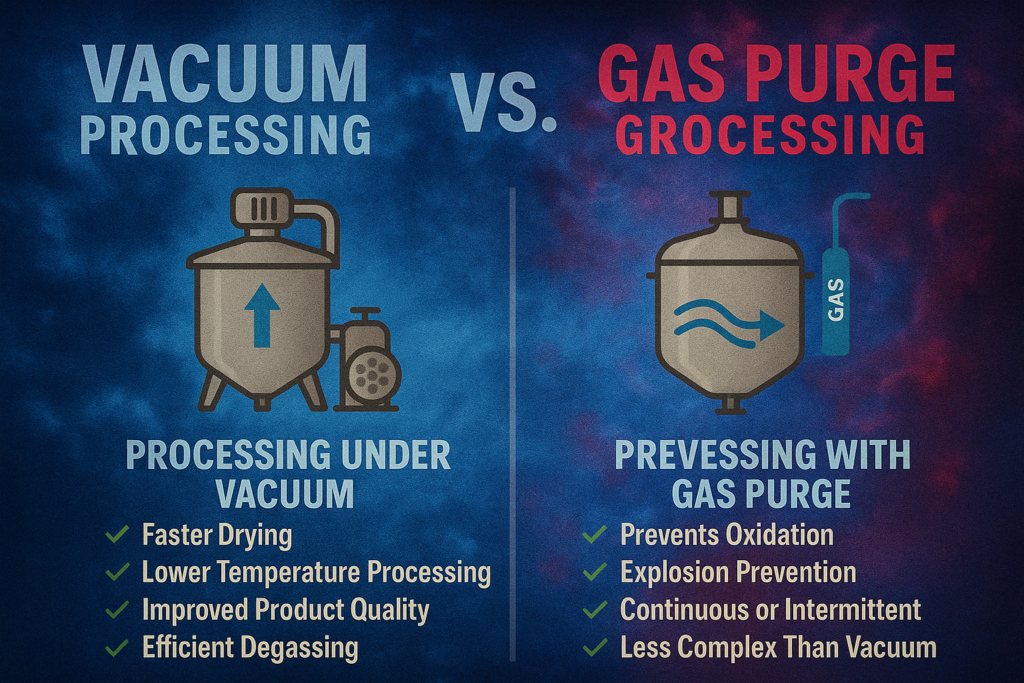
Processing Under Vacuum ➤ Description: In vacuum processing, the internal pressure of the mixing chamber is reduced below atmospheric pressure using a va .
🔁 Processing Under Vacuum
➤ Description:
In vacuum processing, the internal pressure of the mixing chamber is reduced below atmospheric pressure using a vacuum pump. This enables enhanced drying, air removal, and lower-temperature evaporation.
✅ Advantages:
- Faster Drying: Vacuum lowers the boiling point of liquids, accelerating evaporation and reducing cycle times.
- Lower Temperature Processing: Ideal for heat-sensitive materials, since moisture removal occurs at lower temps.
- Improved Product Quality: Eliminates air bubbles, reduces oxidation, and prevents unwanted chemical reactions.
- Efficient Degassing: Removes trapped air or volatile contaminants from powders, pastes, or slurries.
- Energy Savings: Reduced thermal input needed due to lower evaporation temperatures.
❌ Disadvantages:
- Higher Equipment Cost: Requires vacuum-rated seals, jackets, and structural integrity.
- Requires Vacuum Pumps: Increases system complexity and maintenance.
- Moisture-Only Removal: Only water or volatile solvents are removed—oxygen isn’t replaced with inert gas.
- Risk of Product Bumping: Sudden pressure drops can cause product to foam or splash unless carefully controlled.
🌬️ Processing with Gas Purge (e.g., Nitrogen or Argon)
➤ Description:
Gas purge involves displacing the oxygen-rich air inside the mixing chamber with an inert gas (usually Nitrogen or Argon) to create an oxygen-free environment.
✅ Advantages:
- Prevents Oxidation: Inert gas protects oxygen-sensitive products (e.g., metals, catalysts, or organics).
- Explosion Prevention: Displaces oxygen to reduce the risk of fire or explosion with volatile materials.
- Continuous or Intermittent: Can be purged before mixing or continuously flowed during processing.
- Less Complex Than Vacuum: Requires gas supply and purge ports, but not vacuum systems.
❌ Disadvantages:
- Gas Cost: Inert gases can be expensive, especially argon.
- Does Not Remove Moisture: Unlike vacuum, gas purging doesn’t dry materials—it only changes the environment.
- Less Effective at Removing Volatiles: Cannot pull off solvents or trapped air as efficiently as a vacuum system.
- Ongoing Supply Required: Continuous purging consumes gas throughout the cycle.
🆚 Key Differences
💡 When to Choose What:
- Choose Vacuum when: You need drying, degassing, or work with heat-sensitive materials. You want to remove solvents or volatiles. You need faster and more energy-efficient drying cycles.
- You need drying, degassing, or work with heat-sensitive materials.
- You want to remove solvents or volatiles.
- You need faster and more energy-efficient drying cycles.
- Choose Gas Purge when: You process reactive, flammable, or oxidation-sensitive materials. You’re not removing moisture but protecting material integrity. You need explosion protection or ATEX/ExP compliance.
- You process reactive, flammable, or oxidation-sensitive materials.
- You’re not removing moisture but protecting material integrity.
- You need explosion protection or ATEX/ExP compliance.
- You need drying, degassing, or work with heat-sensitive materials.
- You want to remove solvents or volatiles.
- You need faster and more energy-efficient drying cycles.
- You process reactive, flammable, or oxidation-sensitive materials.
- You’re not removing moisture but protecting material integrity.
- You need explosion protection or ATEX/ExP compliance.
Would you like this content formatted for a LinkedIn post or used in a brochure or sales document for PerMix?
Perfect — here’s a sales sheet-style breakdown designed to educate and persuade customers considering PerMix Vacuum Mixers & Dryers, highlighting the differences between vacuum processing and gas purge processing:
🏭 Vacuum Processing vs. Gas Purge Processing
Which is Right for Your Application? PerMix Has You Covered.
PerMix Vacuum Mixers & Dryers are engineered for performance, flexibility, and precision. Whether your process demands deep vacuum for efficient drying or a gas purge system to protect sensitive materials, PerMix delivers with unmatched engineering and value.
🔄 Processing Under Vacuum
PerMix vacuum systems remove air from the mixing chamber, creating a low-pressure environment ideal for drying, deaeration, and sensitive material handling.
✔️ Advantages
- Accelerated DryingVacuum lowers the boiling point, speeding up evaporation of moisture or solvents.
- Low-Temperature CapabilityProtects heat-sensitive ingredients from degradation.
- Zero-Oxygen EnvironmentEliminates oxidation risks—ideal for nutraceuticals, fine chemicals, and sensitive compounds.
- Enhanced Product UniformityRemoves trapped air for denser, more homogeneous mixtures.
- Solvent Recovery-ReadyIntegrates with condensers and collection tanks for safe solvent handling.
⚠️ Considerations
- Requires vacuum pumps and vacuum-rated components.
- Higher upfront cost, but often pays back in efficiency and product quality.
💨 Processing with Gas Purge
Instead of pulling vacuum, inert gases such as Nitrogen or Argon are introduced into the system to displace oxygen and create a protective environment.
✔️ Advantages
- Oxidation ProtectionShields sensitive powders or compounds from atmospheric oxygen.
- Simplified SetupLower cost alternative to vacuum systems—ideal for basic inerting needs.
- Compatible with Continuous ProcessingA practical solution for ongoing batch and flow-through systems.
⚠️ Considerations
- Doesn’t assist in drying or moisture removal.
- Ongoing cost of gas (especially Argon).
- Less effective at removing trapped air within the product.
🧠 Why Choose PerMix?
- Dual Capability: Many PerMix systems allow both vacuum and gas purge operation—built-in flexibility for diverse production needs.
- Full Customization: From food-grade to pharmaceutical and hazardous-duty, PerMix engineers the right solution for your process.
- Affordable Excellence: Industry-leading quality without the inflated price tag.
📞 Let’s Discuss Your ApplicationWhether you’re mixing, drying, or protecting your product during processing, PerMix can engineer a solution that performs and pays back. Contact us today for expert guidance and a quote.