Sanitizing cocoa powder and adjusting its pH using a PerMix Vacuum Paddle Mixer/Dryer is a precise and efficient process. Here’s how it works, step by step:
Sanitizing cocoa powder and adjusting its pH using a PerMix Vacuum Paddle Mixer/Dryer is a precise and efficient process. Here's how it works, step by step:
Sanitizing cocoa powder and adjusting its pH using a PerMix Vacuum Paddle Mixer/Dryer is a precise and efficient process. Here’s how it works, step by step:
How the PerMix Vacuum Paddle Mixer/Dryer Accomplishes This
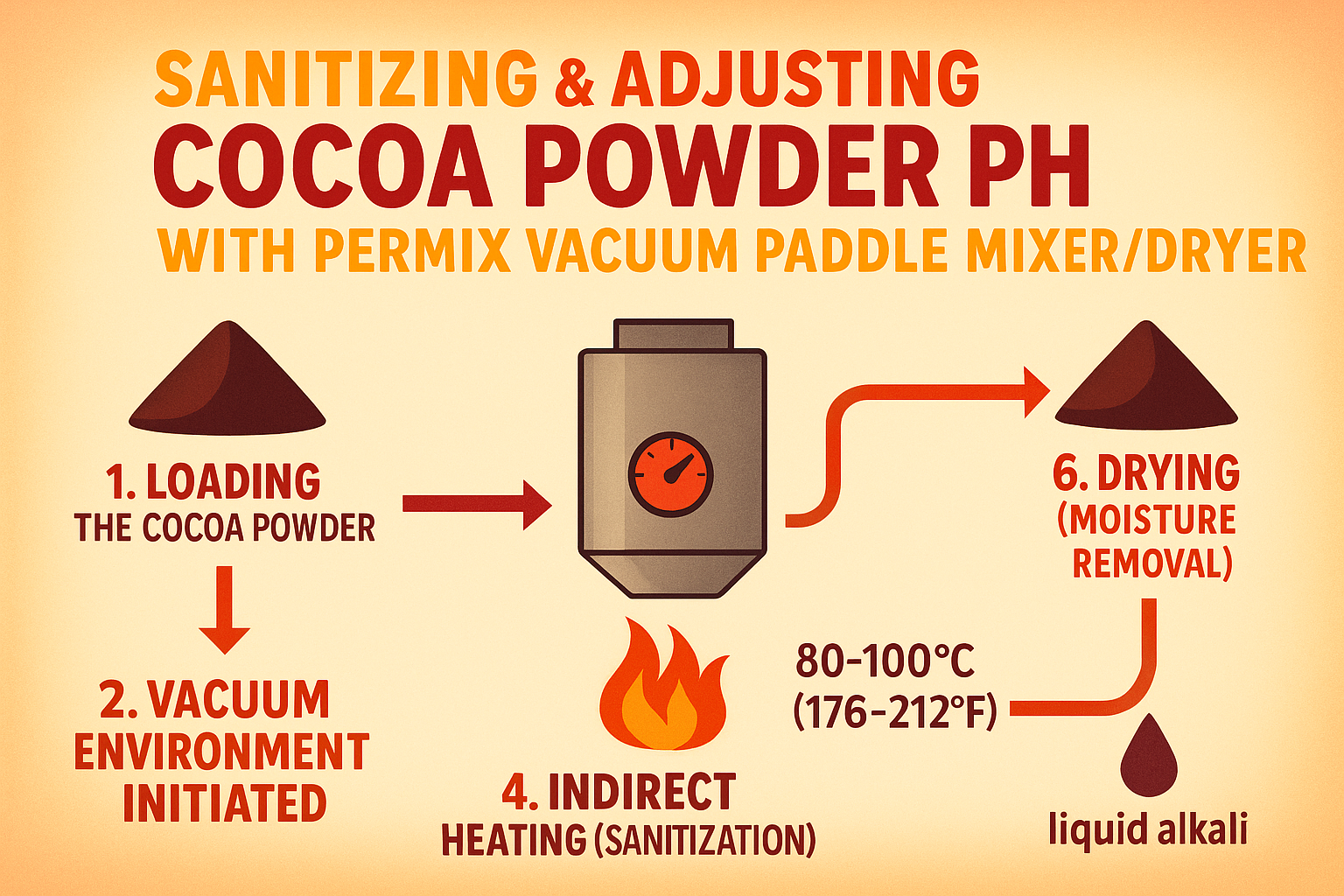
1. Loading the Cocoa Powder
- Cocoa powder is loaded into the mixer under atmospheric or vacuum conditions.
- Optionally, vacuum loading can be used to avoid contamination and dust.
2. Vacuum Environment Initiated
- The chamber is sealed, and vacuum is applied to lower the boiling point of any moisture or added liquids.
- Lower pressure enables sanitization at lower temperatures, protecting volatile flavors and preventing degradation.
3. Indirect Heating (Sanitization)
- The mixer is equipped with a heating jacket (steam, thermal oil, or hot water).
- Heat the cocoa powder to 80–100°C (176–212°F) under vacuum, which is sufficient to kill bacteria, yeast, and mold without damaging quality.
- Paddle agitation ensures uniform heat distribution and prevents hot spots or burning.
4. pH Adjustment Process
- With the vacuum still active (or re-pressurized with inert gas if needed), inject liquid alkali (e.g., potassium carbonate or sodium carbonate) through liquid spray nozzles above the choppers or into the mix directly.
- For Dutch-processed cocoa (alkalized cocoa), this step neutralizes the natural acidity and raises the pH from ~5.0 to ~6.5–8.0, depending on target.
- Choppers (if included) help disperse the liquid evenly and break down agglomerates during the reaction.
5. Mixing & Reaction Time
- Maintain agitation under controlled temperature and vacuum (or slight pressure if using steam).
- Allow sufficient dwell time (20–60 min depending on target pH and temperature) for full pH adjustment and moisture reduction.
6. Drying (Moisture Removal)
- Once sanitization and pH modification are complete, continue vacuum drying to remove residual moisture and solvents.
- Final moisture content is reduced to ≤4%, ensuring shelf stability.
7. Cooling & Discharge
- Optionally use the cooling jacket to bring the cocoa powder to a stable temperature.
- Discharge through a fully open port or screw discharge to minimize degradation of particle structure.
✅ Benefits of Using PerMix for This Process
- Gentle but thorough mixing avoids compacting the powder.
- Uniform pH adjustment with optional choppers and precision liquid dosing.
- Vacuum + heat ensures effective low-temperature sanitization.
- One-step process: sanitize, alkalize, and dry in the same vessel.
CocoaProcessing #FoodTech #PerMix #VacuumDryer #SanitaryMixing #DutchProcessCocoa #FoodManufacturing #CleanLabel #FlavorEngineering #MixingInnovation